

Regenerative Medicine vs. Cortisone: A Guide to Long-Term Joint Restoration in 2026
The quick relief of a cortisone shot might actually be accelerating the very joint decay you’re trying to stop. While many patients view steroids as a standard solution for knee or shoulder pain, clinical data shows that repeated injections can double the rate of cartilage loss compared to a simple saline placebo. When weighing regenerative medicine vs cortisone, the choice isn’t just about how fast the pain disappears. It’s about whether you’re masking a symptom or investing in long-term biological restoration.
You’ve likely felt the frustration of a treatment that works for a few weeks only to leave you back at square one; it’s a cycle that often leads to the very surgery you’re hoping to avoid. We believe you shouldn’t have to accept physical limitations or the sterile feel of a traditional clinic. This guide clarifies the differences between temporary suppression and the sophisticated use of cellular support to restore function. You’ll discover how a mobile concierge approach, led by Dr. Cheesman, DO, brings advanced orthopedic science directly to your door to help you reclaim your vitality.
THIS NOTICE MUST BE PROVIDED TO YOU UNDER FLORIDA LAW. This physician performs one or more stem cell therapies that have not yet been approved by the United States Food and Drug Administration. You are encouraged to consult with your primary care provider before undergoing any stem cell therapy.
Key Takeaways
- Recognize the fundamental shift from pharmaceutical suppression to proactive biological support for long-term mobility.
- Discover how the biological mechanisms of regenerative medicine vs cortisone differ, moving beyond temporary relief toward genuine joint restoration.
- Identify the risks associated with repeated steroid use, including potential tissue degradation, and how to avoid these clinical pitfalls.
- Establish a personalized decision framework to determine if your joint or spine health is ready for advanced, non-surgical intervention.
- Learn how Dr. Cheesman, DO, provides high-end care through a mobile concierge practice that brings advanced protocols directly to your door.
The Pain Management Dilemma: Suppression vs. Restoration
Many patients find themselves trapped in a repetitive cycle of discomfort and temporary relief. Traditional pharmaceutical approaches often address the surface-level symptom of inflammation while the underlying structural issue continues to progress. This creates a critical dilemma. Do you want a brief pause in pain, or are you seeking long-term functional support? When evaluating the long-term impact of regenerative medicine vs cortisone, the distinction lies in the intended outcome: suppression versus restoration.
In Central Florida, active individuals are increasingly moving away from quick-fix injections. They’re looking for solutions that align with a lifestyle of longevity rather than just masking a flare-up. This shift represents a move toward biological restoration. It’s a philosophy that views the body as a capable system that can be supported through precise, scientific intervention rather than just pharmaceutical intervention.
The Traditional Path: How Cortisone Injections Work
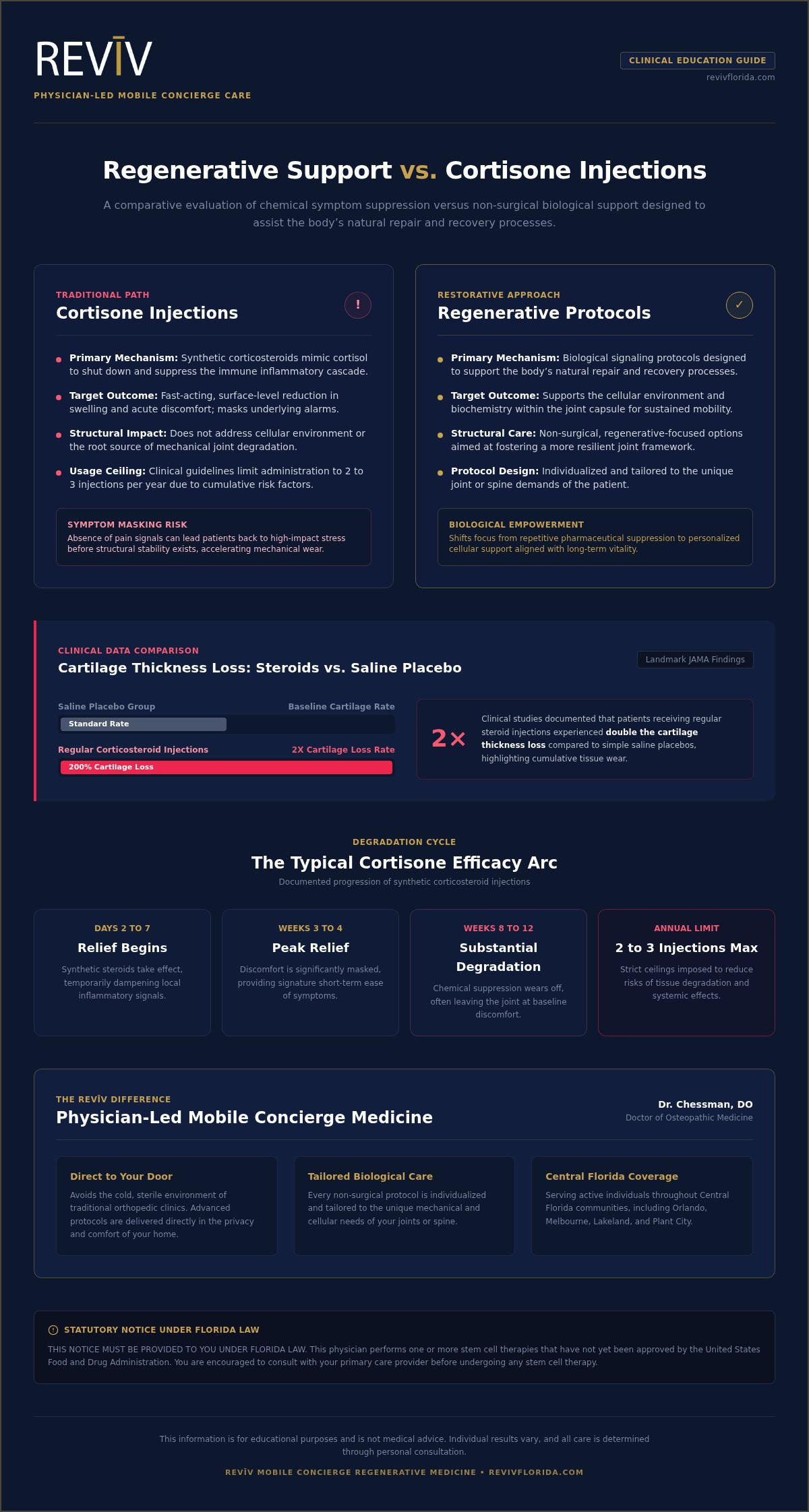
Cortisone injections utilize synthetic corticosteroids to mimic cortisol, a hormone that suppresses the immune system’s inflammatory response. While effective at reducing swelling quickly, these effects are inherently temporary. Relief typically begins within 2 to 7 days and peaks at 3 to 4 weeks. By the 8 to 12-week mark, the effects generally degrade substantially. Orthopedic clinics traditionally recommend these for acute flare-ups. However, they don’t address the cellular environment or the root cause of the joint discomfort.
The Regenerative Path: Supporting the Body’s Natural Processes
Modern regenerative medicine therapies focus on enhancing the local tissue environment rather than simply shutting down a biological response. Instead of chemical suppression, these protocols use biological signaling to support the body’s natural repair and recovery processes. This represents a paradigm shift from masking symptoms to prioritizing cellular health. It’s a more sophisticated way to manage joint and spine concerns.
Navigating these advanced options requires the expertise of a physician-led team. Dr. Cheesman, DO, and the REVĪV mobile concierge practice prioritize this individualized attention. Every protocol is tailored to the specific needs of the patient’s joints or spine. This model brings sophisticated care directly to your home. It avoids the cold, sterile atmosphere of a traditional clinic and puts the focus back on your individual journey toward reclamation and mobility.
Comparing Mechanisms: How They Impact Your Joints
The core distinction in regenerative medicine vs cortisone is the shift from pharmaceutical dependency to biological empowerment. One approach seeks to silence the body’s alarm system, while the other aims to provide the resources necessary for a more resilient joint environment. Understanding these underlying mechanisms is the first step in moving toward a future of sustained mobility and physical reclamation.
In modern non-surgical care, we distinguish between chemical suppression and biological signaling. Cortisone is a synthetic tool designed for speed. Biologics, however, are sophisticated protocols tailored to an individual’s specific cellular needs. They don’t just mask a sensation; they aim to improve the biochemical environment within the joint capsule itself.
Cortisone: The Anti-Inflammatory Powerhouse
Cortisone operates by aggressively shutting down the inflammatory cascade. It blocks the production of enzymes and proteins that cause swelling, providing that signature “numbed” relief. However, this immediate comfort can be deceptive. Because the pain signal is gone, patients often return to high-impact activities before the tissue is structurally ready. This often leads to further mechanical injury and accelerated wear.
Repeated exposure also carries systemic consequences. Corticosteroids can impact metabolic health, potentially elevating blood sugar and affecting bone density. Clinical guidelines from 2026 strictly limit these shots to two or three per year because of the risks of repeated cortisone shots, which include cumulative tissue degradation. In fact, landmark JAMA studies have shown that patients receiving regular steroid injections experienced double the cartilage thickness loss compared to those receiving a saline placebo. It’s a short-term gain that often carries a heavy long-term price.
Regenerative Options: A Wellness-Supportive Framework
Biologics represent a shift toward high-end precision medicine. These protocols use signaling molecules to communicate with the local tissue environment. This process involves two critical components: the scaffold and the signaling. The scaffold provides the structural environment, while growth factors act as the “instruction manual” for cellular support and restoration. It’s a proactive way to manage joint health without the catabolic side effects of steroids.
These options are often integrated into a broader longevity protocol. They don’t just address a single joint; they support a holistic vision of physical function. For instance, the 2026 AAPM&R guidance emphasizes that effective delivery requires a minimum threshold of 10 billion platelets to initiate meaningful symptomatic improvement. This level of scientific rigor is what separates elite restorative care from generic clinical treatments. Dr. Cheesman, DO, focuses on these specific cellular needs during every in-home consultation. If you’re ready to explore how these advanced biologics can support your journey, consider a professional evaluation in the comfort of your own home.
The Impact on Tissue Health: Long-Term Considerations
When comparing regenerative medicine vs cortisone, the most significant factor isn’t the speed of relief. It’s the long-term structural integrity of your joints. Tissue health is the foundation of long-term mobility in aging populations. Choosing a treatment that prioritizes this foundation is essential for avoiding the eventual need for invasive surgery. When choosing between regenerative medicine vs cortisone, you must consider whether the intervention supports your anatomy or merely silences it.
The Cortisone Ceiling: Why More Isn’t Better
Most orthopedic specialists adhere to the “Rule of Three.” This guideline limits patients to no more than three steroid injections in a single joint per year. This limit exists because of the well-documented risks of repeated cortisone shots. Scientific evidence identifies corticosteroids as chondrotoxic. This means they are toxic to the very cartilage cells, known as chondrocytes, that protect your bones. Over time, these chemicals can lead to thinning cartilage and weakened tendons.
Beyond the cellular damage, steroids create a sensory illusion. By masking the pain signal without supporting structural repair, they often encourage patients to return to high-impact activities too early. This leads to accelerated joint wear and mechanical degradation. The true cost of these injections is far higher than the insurance copay; it’s the potential loss of future joint function and the acceleration toward a total joint replacement. For athletes and active individuals seeking specialized care in Spain, consulting an experienced traumatólogo deportivo sevilla can provide sports-focused orthopedic strategies that prioritize genuine tissue recovery over short-term symptom masking.
Building a Foundation for Mobility
Regenerative-focused care takes the opposite approach. Instead of sacrificing tissue for temporary comfort, these protocols prioritize joint preservation. High-quality non surgical treatment for knee pain focuses on the cellular health of the joint capsule. This involves improving the biochemical environment to support the longevity of hips, knees, and the spine. By delivering growth factors and signaling molecules, we aim to support the tissue’s natural ability to maintain its integrity.
Dr. Cheesman, DO, emphasizes a holistic view of musculoskeletal restoration. He recognizes that a single joint doesn’t exist in isolation. It’s part of a complex biological system that requires localized support and systemic wellness. By focusing on the cellular health of the tissue, we aim to maintain a functional joint environment for years to come. This approach is proactive and slightly defiant against the inevitability of physical decline, positioning you as an active participant in your own health journey.
Is Regenerative Medicine Right for You? A Decision Framework
Determining the optimal path for joint restoration requires a shift in perspective. It’s not just about the severity of your pain; it’s about your long-term destination. Many Central Florida residents find themselves at a crossroads after traditional methods fail to provide lasting results. When choosing between regenerative medicine vs cortisone, you must evaluate whether you are managing a temporary flare-up or confronting a progressive biological decline. Your lifestyle goals, such as maintaining a competitive edge on the golf courses of Lake Mary or enjoying long walks in Melbourne, should dictate your clinical strategy.
A sophisticated decision framework considers several key factors. First, identify the stage of your discomfort. Is it a recent injury or a recurring struggle that has persisted for years? Second, review your clinical history. If you’ve already utilized physical therapy and several rounds of steroids with diminishing returns, your joints may be signaling a need for deeper cellular support. Finally, prioritize your outcome. If your goal is to avoid the operating room and reclaim your vitality, a restorative approach is often the most logical progression.
When Cortisone Might Be an Initial Consideration
Steroid injections serve a specific, narrow purpose in orthopedic care. They are often appropriate for acute, high-intensity inflammation that prevents you from participating in basic daily activities. In some cases, Dr. Cheesman, DO, may use a targeted injection for diagnostic purposes. By observing how your pain responds to a localized block, a physician can more accurately identify the precise source of your discomfort. However, using suppression as a long-term strategy is a flawed methodology. It ignores the underlying mechanical issues and, as previously discussed, can lead to cumulative tissue damage that limits your future options.
When to Pivot to Regenerative-Focused Options
The transition to advanced biologics is often the right choice for chronic issues that require more than a temporary pause in pain. For those struggling with back or neck discomfort, regenerative medicine spine Orlando protocols offer a sophisticated alternative to pharmaceutical dependency. These options are ideal for patients who refuse to accept physical limitations and want to avoid the risks and lengthy recovery times associated with surgery.
Choosing this path means choosing a physician-led, concierge experience. You don’t have to navigate crowded waiting rooms or sterile clinics. Instead, you receive high-end care in the comfort of your home, with a protocol tailored to your specific cellular needs. This model respects your time and your desire for a personalized medical journey. If you’re ready to move beyond temporary suppression, you can schedule a professional in-home consultation to explore your options for restoration.
The REVĪV Advantage: Personalized Concierge Care in Florida
Traditional healthcare often feels cold, sterile, and rushed. Patients spend more time in waiting rooms than with their physicians, leaving little space for the deep analysis required for complex joint and spine issues. REVĪV changes this dynamic by bringing advanced medical consultations directly to your home. This mobile concierge practice prioritizes individualized attention, ensuring that your path toward restoration isn’t a one-size-fits-all protocol but a sophisticated strategy designed for your specific biology.
When weighing regenerative medicine vs cortisone, the environment of care matters as much as the science. In-home care removes the friction and stress of navigating traffic and clinical hallways, allowing you to focus entirely on your recovery. Dr. Cheesman, DO, leads this physician-led model, crafting tailored protocols that value your time and your desire for high-end, private medical attention. It’s a proactive approach for those who demand more from their health and refuse to accept the inevitability of physical decline.
Mobile Medical Excellence: Care That Comes to You
We serve residents across Central Florida, from the quiet neighborhoods of Winter Park to the coastal communities of Melbourne. This mobile model is built on the belief that elite medical care should be accessible and thorough. By conducting evaluations and follow-ups in your own environment, Dr. Cheesman, DO, can provide a more comprehensive assessment of your physical function. These unhurried interactions allow for a transparent dialogue about the “why” behind every biological protocol. You aren’t just a number on a chart; you’re a partner in a journey toward physical reclamation.
A Sophisticated Approach to Restoration
Restoration is rarely about a single joint in isolation. It’s about how that joint functions within your entire musculoskeletal system. We integrate longevity medicine Orlando protocols with targeted joint support to create a comprehensive wellness plan. This philosophy of functional restoration focuses on the reclamation of movement and vitality. It’s about moving beyond the limitations of pharmaceutical suppression and toward a future of sustained mobility. Every decision, from cellular signaling to targeted supplementation, is made with your long-term vitality in mind.
Choosing regenerative medicine vs cortisone is a commitment to your future self. It’s a refusal to settle for temporary masks when biological support is available. To explore your individualized path forward, you can request a private consultation in the comfort of your home. This is the first step toward a more resilient, active, and restorative life.
THIS NOTICE MUST BE PROVIDED TO YOU UNDER FLORIDA LAW. This physician performs one or more stem cell therapies that have not yet been approved by the United States Food and Drug Administration. You are encouraged to consult with your primary care provider before undergoing any stem cell therapy.
Reclaim Your Vitality with Biological Precision
Choosing between regenerative medicine vs cortisone is a decision to prioritize your future mobility over a temporary pause in pain. While steroids offer rapid suppression, they often lead to a cycle of recurring discomfort and accelerated tissue wear. By shifting toward biological signaling, you choose a path that supports the body’s natural processes and maintains the structural integrity of your joints. This isn’t just about managing symptoms; it’s about reclaiming the active lifestyle you demand.
Dr. Cheesman, DO, provides a sophisticated alternative through a physician-led mobile concierge model. Serving Central Florida from Orlando to Melbourne, we bring personalized protocols designed for cellular health directly to your door. You don’t have to accept the sterile inconvenience of a clinic or the limitations of pharmaceutical dependency. Take the first step toward a more resilient version of yourself. Request a private consultation with Dr. Cheesman, DO today and discover a restorative approach to your joint and spine health.
THIS NOTICE MUST BE PROVIDED TO YOU UNDER FLORIDA LAW. You are encouraged to consult with your primary care provider before undergoing any stem cell therapy.
Frequently Asked Questions
How does regenerative-focused care differ from a cortisone injection?
The two have different aims: cortisone is used to suppress inflammation for a period of time, while regenerative-focused options are intended to support the joint environment. Which one is appropriate — if either is — is a clinical judgment made after an evaluation. While cortisone provides rapid chemical suppression of inflammation, it doesn’t address the underlying biological environment. In the debate of regenerative medicine vs cortisone, the former focuses on supporting the body’s natural repair mechanisms. This proactive approach helps maintain tissue integrity, whereas repeated steroids can lead to cumulative cartilage degradation over time.
Can I get regenerative therapy if I’ve already had cortisone shots?
You can certainly pursue regenerative options even if you have a history of steroid injections. However, clinical protocols usually require a waiting period of several weeks after your last cortisone shot. This ensures the synthetic steroids have cleared the joint space, allowing the natural signaling molecules in a regenerative protocol to function effectively. Dr. Cheesman, DO, evaluates your injection history during your consultation to determine the optimal timing for your recovery.
How long does it take to see results from regenerative-focused options?
Biological restoration is a gradual process that follows the body’s natural healing timeline. Unlike the near-instant numbing effect of steroids, regenerative therapies like PRP typically take 2 to 6 weeks to initiate symptomatic improvement. These results often peak between 3 and 6 months as the cellular environment stabilizes. This steady progression leads to functional gains that can last significantly longer than the brief 8 to 12-week window provided by traditional cortisone.
Are there side effects associated with regenerative medicine vs. cortisone?
Cortisone carries risks of systemic metabolic impact, including elevated blood sugar and documented chondrotoxicity which damages cartilage cells. When comparing regenerative medicine vs cortisone, regenerative options are generally considered lower risk because they are autologous, meaning they use your own biological material. While you might experience temporary localized soreness or swelling for a few days after the procedure, you avoid the long-term tissue weakening and tendon thinning associated with chronic steroid use.
Why does Dr. Cheesman, DO recommend a mobile concierge model for these therapies?
The mobile concierge model prioritizes individualized attention and eliminates the stress of traditional clinical environments. Dr. Cheesman, DO, believes that a thorough, unhurried evaluation in your own home allows for a more accurate assessment of your daily mobility. This high-end approach ensures that your recovery protocol is perfectly tailored to your lifestyle in Orlando or Melbourne, providing a level of private medical oversight that’s impossible to achieve in a crowded waiting room.
Does insurance cover regenerative medicine like it does cortisone?
Regenerative protocols are specifically designed to delay or avoid the need for invasive surgical procedures. By improving the biochemical environment within the joint and supporting tissue integrity, these therapies can halt the cycle of mechanical degradation. This is particularly effective for patients with mild to moderate osteoarthritis. While “bone-on-bone” cases may still require surgery, many Central Florida residents successfully use these non-surgical options to maintain their vitality and stay out of the operating room. For patients in the UK seeking specialized assessment for lower-limb degeneration or surgical advice, London Hip & Knee Consultant provides dedicated orthopaedic care.
Your consultation is a sophisticated, physician-led evaluation that takes place in the comfort of your living room. Dr. Cheesman, DO, conducts a comprehensive review of your medical history, previous imaging, and specific mobility goals. You’ll receive a clear explanation of your cellular health and a transparent 90-day care plan tailored to your needs. It’s a professional medical experience that values your time and provides a clear, actionable path toward physical reclamation without the friction of a sterile clinic.
THIS NOTICE MUST BE PROVIDED TO YOU UNDER FLORIDA LAW. You are encouraged to consult with your primary care provider before undergoing any stem cell therapy.
Disclaimer
For educational purposes only; not medical advice. Regenerative approaches
referenced are not FDA-approved to diagnose, treat, cure, or prevent any disease.
Individual results vary. Care is determined through individual consultation.
