

Personalized Regenerative Care: What to Expect from an Individualized Approach
What if the first step in regenerative care isn’t choosing a therapy, but explaining what you hope to do and what matters to you? It’s understandable to want clarity when the term can refer to different options, and to wonder whether a suggested plan reflects your needs or follows a standard protocol. Personalized regenerative care should begin with an individual conversation, not an assumption that one approach suits everyone.
During an individualized consultation, a physician-led clinical team can learn about your goals, health context, and preferences, then discuss options that may be relevant. At REVĪV, a mobile concierge practice serving Central Florida, that conversation can take place in your home. Potential benefits depend on personal consultation, and individual results and experiences vary.
This article explains what the process may involve and offers practical questions to ask about evidence, possible risks, and alternatives. It also outlines a measured way to explore your options without pressure to choose a particular approach. This information is for educational purposes and is not medical advice.
Key Takeaways
- Personalized regenerative care starts with your goals and individual context. It doesn’t promise a particular result or mean one protocol fits everyone.
- A physician-led planning conversation can move from discussing your goals and health context to considering relevant options and next steps.
- Ask why an option may fit your goals, what evidence and risks to consider, and what alternatives are available.
- Prepare questions and relevant health information, and speak with your clinicians before making changes to your existing care.
- REVĪV’s mobile concierge practice offers in-home consultations in Central Florida to discuss spine and joint concerns, neuropathy care, and wellness-oriented options.
What Personalized Regenerative Care Means for Your Individual Goals
Personalized regenerative care starts with a conversation about you, not a preset protocol. A physician considers your priorities, daily life, health context, and preferences before discussing which options may be relevant. The term “regenerative medicine” covers a broad area of care and research, as described in this overview of regenerative medicine. That broad definition doesn’t mean every approach is appropriate for every person.
Depending on the option and individual consultation, care may be designed to support the body’s natural repair and recovery processes. But “regenerative” describes an approach, not a forecast. It doesn’t promise a specific result or mean one protocol will suit everyone. A clinician can discuss whether an option may be appropriate for your circumstances and what considerations apply. Suitability and potential benefits require personal consultation, and individual experiences vary.
How individual goals shape a care conversation
Your goals can make the conversation more useful and specific. You might want to discuss comfort during everyday activities, maintaining mobility, or exploring broader wellness priorities. These are valuable discussion points, not guaranteed clinical outcomes. A physician-led team can consider what you hope to maintain or improve alongside your health context and preferences.
Before a consultation, think about what matters most in your day. Is there an activity you’d like to approach with greater ease, or a wellness priority you want to discuss? Describe your goals in practical terms. Clear examples can help the clinician understand your perspective and explain which options, if any, may be worth considering.
What regenerative-focused care does, and doesn’t, promise
In plain language, regenerative-focused care refers to options intended to support the body’s natural processes. That description doesn’t establish what an individual will experience or show that a particular option is suitable for them. A clinician should discuss any recommendation in light of your goals and health context, including uncertainties and alternatives.
A concise definition: Personalized regenerative care is a consultation-led discussion of individual goals and relevant options that may support the body’s natural repair and recovery processes. Suitability is determined through personal consultation, and individual experiences vary.
This distinction helps set realistic expectations. You can explore possibilities without assuming a specific outcome or feeling committed to a particular plan. The purpose of an individualized discussion is to understand the available options and whether they align with your preferences. For individuals weighing different wellness modalities, resources from the Quantum Resonant Healing Center explore how individualized care approaches and specialized therapies can be compared to match unique goals.
How a Physician-Led Personalized Care Plan Takes Shape
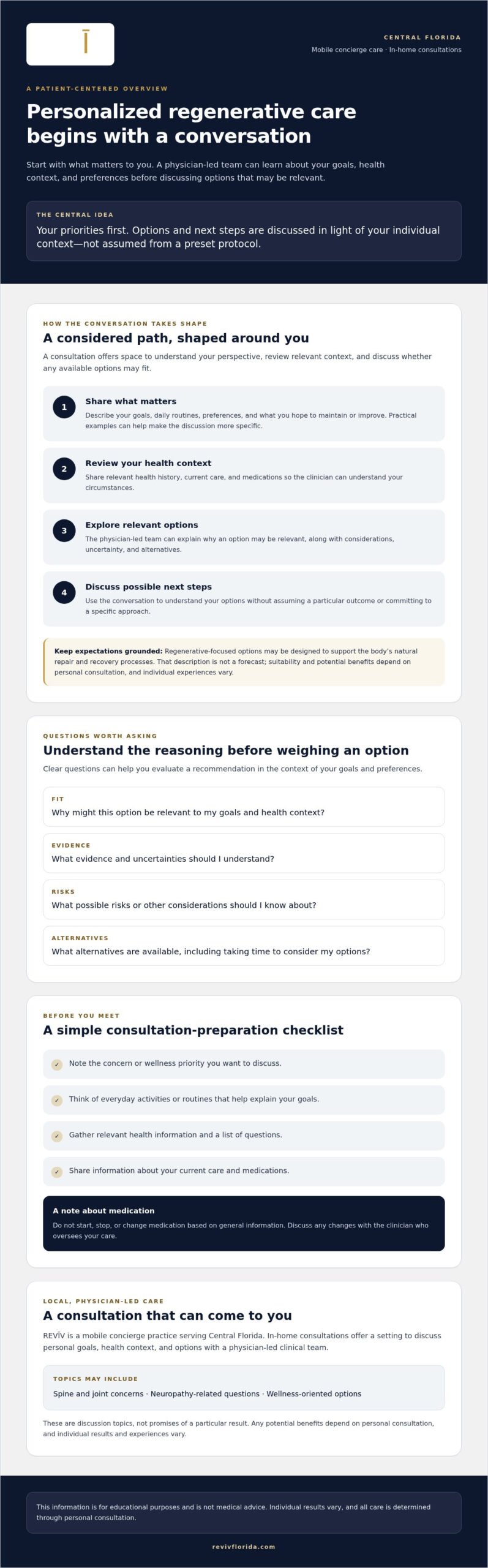
A personalized care plan develops through discussion, not assumption. In a physician-led consultation, the clinician can learn what you hope to maintain or improve, review relevant health context, consider whether available options may fit, and discuss possible next steps. This sequence offers a general picture, not a substitute for a clinician’s individual judgment. Suitability and potential benefits depend on personal consultation, and individual experiences vary.
Personalization can look different across the field. For example, a U.S. Department of Veterans Affairs example of personalized regenerative medicine describes work involving 3D bioprinting and a patient’s own cells. That example illustrates an approach in a specific context. It shouldn’t be taken as a description of what’s available to everyone or a prediction of what an individual may experience.
What to share during an initial consultation
Start with the concern you want to discuss and how it affects everyday routines. For instance, explain which movements or activities you’d like to approach differently and share your broader care priorities. Include relevant health history and bring a list of questions. Clear information about your circumstances and preferences can help ground the conversation.
Share information about your current care and medications so the clinician has context. Don’t start, stop, or change medication based on general information or this article. Discuss any changes with the clinician who oversees your care.
How options and next steps are discussed
After reviewing your context, the physician-led team can explain whether available options may be relevant and why. Ask about the reasoning behind a recommendation, its possible limitations, alternatives, and what follow-up may involve. You can also ask what the next step would look like before deciding whether to proceed.
Sometimes the appropriate next step is more discussion, gathering information, or considering alternatives rather than choosing a therapy. At REVĪV, an in-home consultation is one way for Central Florida patients to discuss goals and relevant options with a mobile concierge practice. For related context on care delivered in the home, read about mobile regenerative medicine in Orlando. You can also learn about REVĪV’s in-home care at your own pace.
This information is for educational purposes and is not medical advice. Individual results vary, and all care is determined through personal consultation.
How to Evaluate a Personalized Regenerative Care Recommendation
A recommendation should come with a clear explanation, not just a label. To assess whether a plan is genuinely individualized, listen for how the clinician connects an option to your stated goals and relevant health context. Personalization can guide a thoughtful discussion, but it doesn’t establish suitability or predict a particular result. Potential benefits depend on personal consultation, and individual experiences vary.
Individualized planning: The clinician asks about your priorities and relevant history, explains why an option may fit those goals, and discusses uncertainty and alternatives.
One-size-fits-all pitch: The same recommendation is presented as right for everyone, with little discussion of your circumstances or a clear explanation of its rationale.
Questions that reveal whether a plan is truly individualized
Ask direct questions to understand how the recommendation was formed. For example: “How do my goals and health history shape the options we’re discussing?” and “What is known, and what remains uncertain?” You can also ask what alternatives may be appropriate, how the team will explain next steps, and how your experience will inform future discussions.
A thoughtful answer should be understandable and specific to your conversation. If something is unclear, ask for a plain-language explanation before deciding what to do.
Warning signs in claims and expectations
Be cautious of promises of a certain result, claims that an option will cure or fix a condition, unsupported statistics, or pressure to make a quick decision. Such claims don’t replace a balanced discussion of potential limitations and alternatives. A clinician can communicate clearly while acknowledging uncertainty and the fact that people’s experiences differ.
A personalized discussion is not a promise of a particular result. Its value is in considering your circumstances, explaining the reasoning, and giving you space to weigh the information. If an answer doesn’t address your concerns, ask follow-up questions or take time to consider your options.
Before moving forward, make sure you understand what is being proposed, why it may align with your goals, and what other paths you can discuss with your clinicians. If you are comparing different treatment philosophies, you can read more about holistic modalities and natural healing to see how individualized care is structured across different wellness disciplines. The decision should follow an individualized conversation, not persuasive language alone.
How to Prepare for a Regenerative Care Consultation
A little preparation can help you use consultation time well. It gives the clinical team a clearer picture of what matters in your daily life and what you’d like to understand. A checklist can organize the conversation, but it can’t determine whether an option is suitable. That requires a clinician to consider your individual circumstances and discuss them with you.
Information to organize before the appointment
Make a short note of the concerns you want to discuss, how they affect everyday activities, and what you hope to maintain or improve. Include your preferences and questions. You don’t need to arrive with a particular plan in mind.
- Daily impact: Describe the activities or routines you’d like the clinician to understand.
- Relevant health context: Gather health history and information about current care that may help frame the discussion.
- Personal priorities: Note what matters most to you, including preferences or concerns about possible options.
- Questions: Write down anything you want clarified, such as why an option is being discussed or what alternatives may be worth considering.
Share information about your current care with the clinical team. Don’t stop, start, or change medication or other care on your own. Speak with the clinician responsible for it. If you’re exploring knee-related options, this overview of non-surgical knee pain care may help you prepare questions for a personal discussion.
Questions to ask about safety, fit, and follow-up
Use the consultation to understand how the clinician is considering your circumstances. You might ask:
- Which personal factors may influence whether an option is appropriate for me?
- What limitations or uncertainties should I understand?
- What alternatives could I discuss with my clinicians?
- How will we talk about my experience and decide on any next steps?
These questions can clarify the reasoning behind a recommendation without assuming that a particular option is right for you. Take the time you need to understand the discussion. Ask for an explanation in plain language or consider the information before choosing a next step.
REVĪV is a physician-led mobile concierge practice offering in-home consultations in Central Florida. To discuss your goals and questions with the clinical team, request a private consultation. Options are considered through personal consultation, and individual experiences vary.
Explore Personalized Regenerative Care with REVĪV in Central Florida
REVĪV is a physician-led mobile concierge regenerative medicine practice serving patients in Central Florida. The clinical team brings consultations to patients in their homes. Its local service context includes Orlando, Melbourne, Winter Park, and Maitland. Confirm current coverage and consultation details when making an inquiry.
For people exploring personalized regenerative care, an in-home consultation offers a setting to discuss individual goals, relevant health context, and possible next steps with the clinical team. An in-home visit doesn’t determine eligibility or establish what the experience will be like. Options and potential benefits are considered through personal consultation, and individual experiences vary.
What an in-home concierge consultation offers
The mobile model means the conversation takes place where the patient is, rather than at a walk-in location. It provides an opportunity to explain what matters in daily life, ask about relevant options, and understand how the team approaches individual circumstances. An in-home visit doesn’t establish what level of convenience to expect or what clinical outcome may follow. It’s a setting for discussion, with suitability determined through personal consultation.
How REVĪV’s care areas relate to individual goals
REVĪV offers regenerative-focused care for spine and joint concerns, including the back, hip, knee, and shoulder; dedicated neuropathy care; and wellness-oriented targeted supplementation, including cellular health and NAD+ protocols. These are areas for individualized discussion, not a universal menu or an indication that any option is right for a particular person. A physician-led consultation helps determine whether an option may align with a person’s goals and context.
For a focused educational discussion, read more about neuropathy care in Orlando. If you’d like to explore whether an in-home conversation is a suitable next step, you can request a private consultation. There’s no pressure to pursue a specific option.
Individual results vary, and all care is determined through personal consultation.
Take the Next Step at Your Own Pace
The most useful starting point for personalized regenerative care is a thoughtful conversation about your goals, relevant health context, and preferences. A recommendation should come with a clear explanation of why an option may fit, what remains uncertain, and what alternatives you can consider. Personalization makes the discussion relevant to you, but it doesn’t promise a particular outcome.
REVĪV’s physician-led clinical team offers mobile concierge consultations in the patient’s home, creating space to explore relevant care options without pressure to pursue a specific approach. Individual suitability and potential benefits are determined through personal consultation, and experiences vary.
If you’re ready to explore your questions, request a private consultation. Begin with a conversation, take time to consider what you learn, and choose a next step that feels right for you.
Frequently Asked Questions
What is personalized regenerative care?
Personalized regenerative care is a consultation-led discussion of your goals, health context, and relevant options. Depending on individual circumstances, options may be designed to support the body’s natural repair and recovery processes. The phrase describes an individualized approach, not a prediction about what you’ll experience. A physician can discuss whether an option may be appropriate for you, and individual results and experiences vary.
How does a physician decide whether regenerative-focused care may suit me?
A physician reviews relevant health history, current concerns, personal priorities, and preferences before discussing possible options. You can help by describing how a concern affects everyday activities and what you’d like the clinician to understand. Ask how those details inform the discussion and what factors may affect suitability. General information can’t determine what is appropriate for you. That requires an individual consultation.
Can regenerative care be tailored to my goals and health history?
A consultation gives you and the physician-led clinical team an opportunity to discuss your priorities, relevant health history, current care, and preferences. That information can shape which options may be worth exploring. Bring a brief list of questions or relevant health information to make the most of the conversation. Individual suitability and experiences vary, so a personal discussion is essential.
Does personalized regenerative care promise a specific result?
No. Personalization means that your goals and relevant context inform a discussion of possible options. It doesn’t promise a particular result or require you to pursue a specific approach. Ask the clinician to explain the reasoning, what remains uncertain, and what alternatives may be relevant. A clear conversation can help you weigh the information while recognizing that individual experiences vary.
What should I ask during a regenerative care consultation?
Ask how your goals and health history inform the options being discussed, what is known and uncertain, and what alternatives may be relevant. You might also ask what follow-up conversations could involve and how the team will discuss your experience. If an explanation isn’t clear, ask for plain language or more time to consider it. You don’t need to decide before you understand the discussion.
Can I explore regenerative care without changing my current medical care?
You can discuss possible options while sharing information about your current care with the clinician. Don’t stop, start, or change medication or other care based on general information. Speak with the clinician who oversees your care before making changes. This keeps the conversation connected to your broader health context while allowing you to explore questions without independently altering your existing care.
Does REVĪV offer in-home consultations in Central Florida?
REVĪV is a physician-led mobile concierge practice that brings consultations to patients at home. Its Central Florida service context includes Orlando, Winter Park, Maitland, Altamonte Springs, Longwood, Casselberry, Orange City, DeLand, Deltona, Apopka, Oviedo, Winter Springs, Lake Mary, Sanford, Kissimmee, Winter Haven, Davenport, Titusville, Melbourne, and Melbourne Beach. Confirm current coverage when inquiring, since service availability depends on location.
Disclaimer
For educational purposes only; not medical advice. Regenerative approaches
referenced are not FDA-approved to diagnose, treat, cure, or prevent any disease.
Individual results vary. Care is determined through individual consultation.
