

Is NAD+ Therapy Worth It for Anti-Aging? Evidence, Limits, and What to Consider
A plausible biological rationale isn’t the same as a demonstrated anti-aging result. So, is NAD+ therapy worth it for anti-aging? The answer depends on what you hope to gain, what the research can show, and whether a personalized approach makes sense for your health context.
It’s understandable to be drawn to claims about energy, vitality, and longevity. NAD+ plays a role in essential processes inside the body, but that doesn’t establish that NAD+ therapy can slow aging or deliver noticeable benefits. Human research on oral NAD+ precursors is more developed than research on IV NAD+, and anti-aging outcomes remain uncertain. Rigorous trial evidence for IV therapy is lacking.
This article separates the biological rationale from the claims, explains what current evidence can and can’t tell us, and offers a practical way to weigh potential value, safety, and personal suitability. REVĪV’s physician-led mobile concierge team, including Dr. Cheesman, DO, offers NAD+ protocols as part of personalized wellness and longevity care. For Central Florida patients, a private consultation can help determine whether an individualized protocol fits your goals and health context. Individual experiences vary, and potential benefits should be considered through personal consultation.
Key Takeaways
- Separate NAD+’s role in cellular processes from claims that it can slow aging or create noticeable changes.
- To assess whether NAD+ therapy is worth it for anti-aging, look beyond biomarkers and consider what human studies show about meaningful outcomes.
- Use a clear decision framework: define your goal, review the evidence, discuss your health context with a clinician, and set realistic expectations.
- Compare NAD+ protocols with foundational wellness habits by their goals, evidence, and unanswered questions, rather than assuming one approach is best for everyone.
- A personalized consultation can help you consider whether NAD+ fits your wellness goals. Individual experiences vary.
Is NAD+ Therapy Worth It for Anti-Aging? Start With What You Want From It
Wanting to stay energetic, capable, and well as you age is understandable. The key is to separate personal wellness goals from claims that a therapy can turn back the clock. If you’re asking, “is NAD+ therapy worth it for anti-aging,” begin by defining what “worth it” would mean to you. Then weigh that goal against the evidence, your health context, and the value of informed clinical guidance.
In brief: NAD+ is a molecule that helps cells carry out energy-related processes. Its biological importance does not, on its own, show that NAD+ therapy slows aging or makes someone look younger.
What does NAD+ do in the body?
NAD+ stands for nicotinamide adenine dinucleotide. It’s present in cells and participates in reactions that help convert nutrients into usable energy. It also has roles in other cellular processes, which is why researchers study NAD+ and related molecules as part of broader questions about health and aging.
Nicotinamide mononucleotide, or NMN, is one molecule the body can use in the process of making NAD+. The overview of NMN and NAD+ biosynthesis describes this relationship. But a role in cell biology is not the same as evidence that a therapy produces a meaningful change in how people feel, function, or age. A mechanism can help researchers ask useful questions, but it cannot answer those questions by itself.
What do people mean by anti-aging?
“Anti-aging” can describe different aims. For one person, it may mean supporting skin appearance; for another, maintaining energy for daily activities, preserving physical function, or making thoughtful long-term wellness choices. Those goals aren’t interchangeable, and a change in a laboratory marker would not necessarily mean a visible or functional change.
Before considering a protocol, write down the outcome you care about in plain language. For example, are you hoping to feel more prepared for an active day, or are you focused on appearance? Clarifying your goal helps keep expectations grounded and makes a clinical conversation more useful. It also gives you a clearer basis for deciding whether a proposed approach is relevant to your priorities.
Consider NAD+ as one possible part of an individualized wellness discussion, not as a stand-alone promise of age reversal. A clinician can discuss your goals, health history, current medications, and personal circumstances before considering whether a tailored protocol may be appropriate. Potential benefits depend on individual consultation, and experiences vary. A useful starting point is a clear understanding of what you hope to support and what current evidence can reasonably say.
What NAD+ Research Can, and Cannot, Tell Us About Aging
NAD+ research spans several kinds of evidence, and each answers a different question. Laboratory studies can suggest how a biological process works. Human studies can test whether an intervention changes a marker or a measured outcome. Evidence that examines outcomes meaningful to people can begin to address whether a therapy supports how someone feels or functions. These steps matter, but they aren’t interchangeable.
Quotable summary: The strength of NAD+ evidence depends on what outcome was measured, in whom, and how the study was designed.
Why a plausible cellular mechanism is not proof of anti-aging benefit
A proposed mechanism describes how NAD+ might participate in a process. It doesn’t establish that increasing NAD+ through a particular protocol will produce a desired result in people. Researchers may measure NAD+ levels or related markers, but a change in a marker doesn’t automatically mean better energy, physical function, quality of life, or slower aging.
Study design helps show how much confidence to place in a finding. Small or short studies may not reveal whether an effect lasts or applies to a broader population. A comparison group helps distinguish an intervention’s effects from changes that might occur anyway, while the chosen endpoint determines what the study actually answers. Results from one group or protocol shouldn’t be assumed to apply to another.
Which outcomes would matter to a person considering NAD+?
Some human studies of oral NAD+ precursors have measured whether supplementation changes NAD-related markers. For example, Martens and colleagues’ randomized trial of nicotinamide riboside in healthy middle-aged and older adults examined tolerability and NAD+ levels. Yoshino and colleagues studied NMN in a specific group of women and measured muscle insulin sensitivity. These studies examined particular precursors, populations, and endpoints. They don’t establish that NAD+ therapy slows aging, extends lifespan, or makes a person feel younger.
That distinction is central to interpreting the findings. A laboratory change asks, “Did a biological marker move?” Someone considering a wellness protocol may also want to know, “Did my day-to-day function, wellbeing, or quality of life change?” Those are separate questions, and an answer to the first doesn’t settle the others. Findings may also differ by compound, protocol, population, and outcome studied.
For IV NAD+ specifically, published randomized controlled trials validating anti-aging or general wellness outcomes in humans are lacking. That leaves uncertainty about whether it delivers meaningful benefits for those goals. It’s a reason to be measured, not to dismiss the biology or assume a result.
So, is NAD+ therapy worth it for anti-aging? The evidence doesn’t support a simple yes or no. It supports a careful discussion of the specific approach, the outcome you value, and what remains unknown. An individualized consultation can help put those questions in context. Individual experiences vary. To discuss whether a NAD+ protocol fits your personal wellness goals, request a private consultation.
NAD+ Therapy vs. Other Anti-Aging Approaches: Compare the Right Things
Comparing options is more useful when you look at what each is intended to support and what research has actually measured. NAD+ protocols, everyday wellness habits, and clinician-guided care address different goals. None should be treated as a guarantee against aging, and this educational comparison isn’t a substitute for individualized medical guidance.
NAD+ protocols and foundational wellness habits
Sleep, nutrition, movement, and preventive care can all be part of a broader wellness plan. They differ from a targeted NAD+ protocol, which focuses on NAD+ biology. Rather than assuming one approach is superior, consider your priorities and circumstances. You might want to build a steadier sleep routine, discuss a personal health goal with a clinician, or learn more about NAD+.
How to interpret claims about supplements, infusions, and other protocols
Route matters because findings for one form can’t automatically be applied to another. Human research on oral precursors such as NMN and NR has examined changes in NAD-related levels, while meaningful effects on wellbeing and function remain uncertain. Rigorous randomized trials assessing IV NAD+ for anti-aging or general wellness outcomes are lacking. Neither route should be assumed to be inherently superior.
Use the comparison below as a starting point, not a ranking. Evidence maturity depends on the exact intervention and outcome studied.
| Approach | Evidence maturity | Intended goal | Individual considerations | Unanswered questions |
|---|---|---|---|---|
| NAD+ protocols | Human evidence differs by protocol. Oral precursor studies have assessed NAD-related markers; IV wellness outcomes have limited rigorous trial evidence. | Explore whether a targeted approach fits a cellular health or wellness goal. | Form, health history, medications, personal goals, and clinician guidance matter. | Would the protocol affect an outcome that matters to you, such as function or wellbeing? |
| Sleep, nutrition, and movement | Broadly studied as health habits, though findings about one habit don’t promise a particular aging outcome. | Support everyday wellbeing and sustainable routines. | What’s practical depends on personal health, preferences, and circumstances. | Which routine is realistic and relevant to your needs? |
| Preventive and clinician-guided care | Varies by the specific care and question being considered. | Discuss health priorities and make informed decisions with clinical context. | Personal history and existing care should inform the conversation. | Which options are appropriate for your individual situation? |
Be cautious with claims that promise a younger appearance, longer life, or a predictable boost in energy without clarifying what was studied. Ask what the protocol involves, which outcome was measured, and whether that finding applies to your goal. If you’re weighing whether NAD+ therapy is worth it for anti-aging, a personalized discussion can help put its potential role and limits in context. REVĪV’s physician-led team offers mobile concierge consultations for wellness and longevity care. Individual experiences vary.
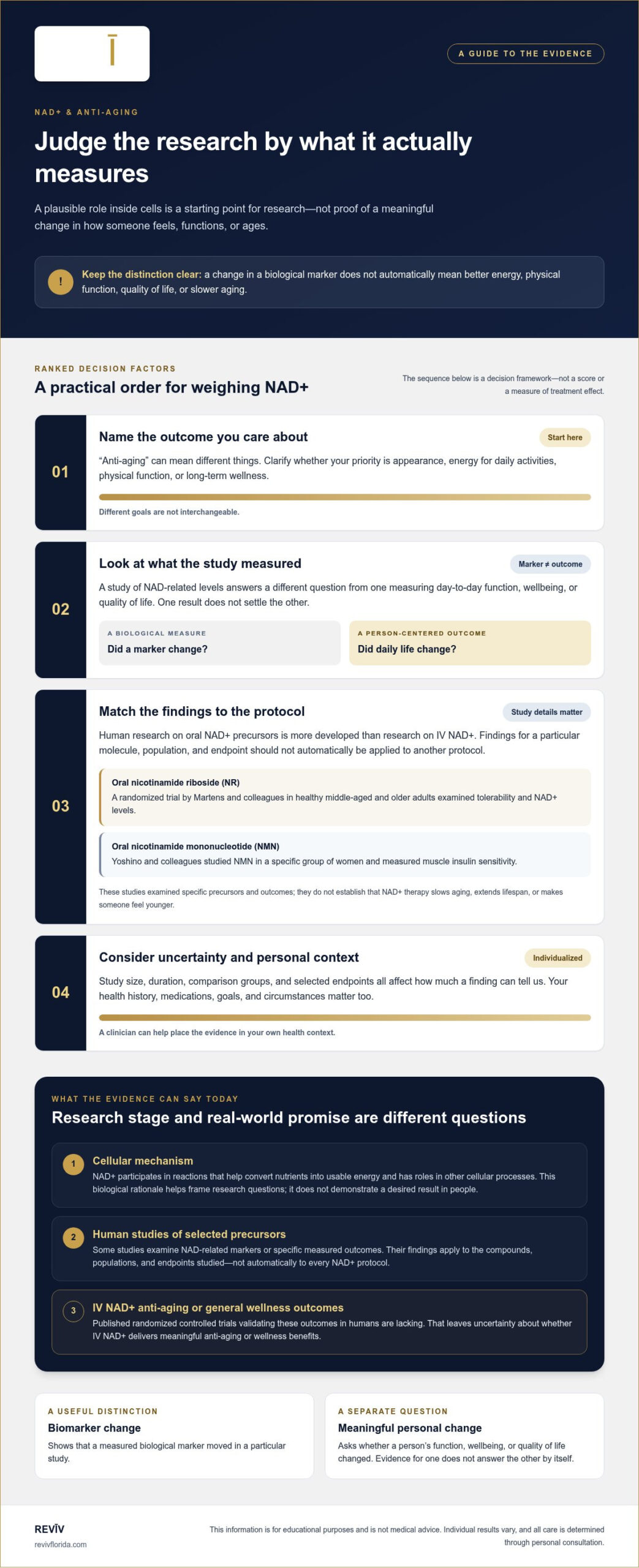
How to Decide Whether NAD+ Therapy Fits Your Goals
A thoughtful decision doesn’t require certainty about every research question. It does call for a clear goal, an honest look at what’s known, and a conversation that considers your circumstances. Use this framework to prepare for a clinician-led discussion, not as a substitute for personalized medical guidance.
- Define the goal. Write down what you hope to support, such as a particular aspect of wellbeing or daily function. A specific goal makes it easier to discuss whether a protocol is relevant.
- Review the evidence. Ask what research applies to the proposed protocol and whether it measured a result that matters to you. Be clear about what remains uncertain.
- Discuss your context. Share your health history, current medications, relevant concerns, and personal circumstances with the clinical team. These details help inform an individualized conversation about suitability and potential downsides.
- Reassess expectations. Before proceeding, clarify what would count as a meaningful change, how progress might be evaluated, and when the plan should be reconsidered.
Questions to bring to a private consultation
Consider asking: What is this protocol intended to support? Which outcomes are still uncertain? What potential downsides should I understand? How does my health history or medication list affect the discussion? What alternatives might better match my goal? How would the plan be tailored to me, and what would prompt the clinical team to reassess it?
When a cautious or different approach may make sense
You may decide that the evidence doesn’t yet match your expectations. That’s a reasonable conclusion. It’s also fine to pause if your goal is unclear, you need more time to understand the uncertainties, or you want to focus on other wellness priorities first. NAD+ isn’t necessary for healthy aging, and no single approach suits everyone.
In a private conversation, a physician-led team can help place a NAD+ protocol alongside your goals and broader wellness considerations. REVĪV is a mobile concierge practice, bringing care to patients in Central Florida. Its approach is personalized, and individual experiences vary. Consider how in-home care and longevity medicine may fit your needs.
If you’re weighing whether NAD+ therapy is worth it for anti-aging, a no-pressure consultation can help you discuss the rationale, uncertainties, and personal considerations. A private consultation offers space to explore whether an individualized NAD+ protocol may align with your wellness goals.
How REVĪV Approaches NAD+ and Personalized Longevity Care
NAD+ is best considered as one possible part of a broader, individualized wellness conversation, not a stand-alone promise about aging. REVĪV is a physician-led mobile concierge practice serving Orlando and Central Florida. Care comes to the patient, creating space to discuss personal goals and relevant health context in a familiar setting.
During a consultation, Dr. Cheesman, DO, and the clinical team can discuss targeted NAD+ protocols within personalized wellness and longevity care. The aim is to understand what you hope to support, explain the rationale for any proposed approach in clear language, and keep expectations aligned with what is known and what remains uncertain. Potential benefits depend on individual consultation, and experiences vary.
What an individualized conversation should cover
A useful discussion starts with your priorities, not a preset protocol. You might want to talk about energy, daily function, or a broader interest in cellular health. The team can consider those goals alongside your health history, current medications, and personal circumstances. This context helps shape a conversation that is relevant to you rather than based on a general claim.
You should also have room to ask questions. What is the proposed protocol intended to support? What is uncertain about its potential effects? What potential risks or alternatives should be considered? How would the team assess whether the plan still fits your goals? A clear explanation can help you make an informed decision, including the decision to wait or choose another focus.
For a broader perspective, explore what NAD+ therapy may support as part of a thoughtful longevity discussion. The central question is not whether a protocol promises to change aging, but whether its proposed role makes sense in light of your priorities and the limits of current evidence.
A considered next step for Central Florida residents
A mobile concierge consultation offers a way to have this discussion with care delivered to you, without assuming that a protocol will be suitable or produce a particular outcome. REVĪV’s physician-led clinical team can discuss whether targeted NAD+ protocols and supplementation fit within an individualized wellness and longevity plan. Care is available in Orlando, Winter Park, Maitland, Altamonte Springs, Longwood, Casselberry, Orange City, DeLand, Deltona, Apopka, Oviedo, Winter Springs, Lake Mary, Sanford, Kissimmee, Winter Haven, Davenport, Titusville, Melbourne, and Melbourne Beach. Your questions, medical context, and expectations all matter.
If you’re still weighing whether NAD+ therapy is worth it for anti-aging, there’s no need to rush the decision. A private conversation can help you clarify what you want to support and what remains uncertain. Request a private consultation when you’re ready to discuss your goals with the clinical team.
This information is for educational purposes and is not medical advice. Individual results vary, and all care is determined through personal consultation.
Make Your Next Step a Thoughtful One
The question “is NAD+ therapy worth it for anti-aging” doesn’t need a universal answer. What matters is whether a specific approach aligns with your priorities and whether its uncertainties feel acceptable to you. You can take time to reflect, bring your questions to a clinician, and decide that waiting or choosing another wellness focus is the right step for now.
A useful starting point is one clear goal: what would you hope to support, and how would you recognize a meaningful change in your everyday life? Discussing that goal in a personalized consultation can help bring the decision into focus. Potential benefits depend on your individual circumstances, and experiences vary.
If you’d like a thoughtful conversation about your wellness goals, REVĪV’s clinical team can help you consider an individualized path forward. Explore a private consultation when it feels right for you. Your next step can be informed, personal, and unhurried.
Frequently Asked Questions
Is NAD+ therapy proven to reverse aging?
No. Current evidence doesn’t establish that NAD+ therapy reverses aging or extends lifespan in people. Some human research on oral precursors has examined changes in NAD-related markers, but a marker change isn’t the same as a demonstrated effect on how someone feels or functions. Research findings also depend on the specific protocol and outcome studied. Be cautious of claims that promise age reversal or a predictable result.
Can NAD+ therapy make you look younger?
There isn’t enough evidence to say NAD+ therapy makes people look younger. Research on cellular processes doesn’t establish a visible change in skin or appearance. If appearance is your main goal, define what change you’re hoping for and discuss whether the available evidence relates to that outcome. A clinician can help you consider whether a proposed wellness protocol fits your priorities while keeping expectations realistic. Individual experiences vary.
How long does it take to notice an effect from NAD+ therapy?
There’s no established timeline for noticing a wellness or anti-aging effect. Studies don’t provide a reliable schedule that applies across different NAD+ protocols, people, and desired outcomes. Before starting, ask what changes could reasonably be observed, how you might track them, and when the plan would be reviewed. A simple record of your original goal and day-to-day experience can support a more specific follow-up conversation.
Is NAD+ therapy safe for everyone?
No, a protocol shouldn’t be assumed suitable for everyone. Safety considerations can depend on the specific product or approach and a person’s health circumstances. Before considering NAD+, share your health history, current medications, and supplements with a clinician, and ask about potential risks and what to do if you notice an unexpected reaction. Don’t stop or change prescribed medication to accommodate a wellness protocol without guidance from the clinician who manages it.
What is the difference between NAD+ therapy and NAD+ supplements?
They may involve different compounds and ways of taking them, so they shouldn’t be treated as interchangeable. Many oral products contain NAD+ precursors, such as NMN or NR, while an NAD+ protocol may refer to a clinician-guided approach. Research on one precursor or route doesn’t establish the effects of another. Check the exact ingredient and intended use, and discuss how it fits with other supplements or medications you take.
Is NAD+ therapy worth the cost for anti-aging?
Whether it’s worth the cost depends on your goal, the protocol being considered, and how comfortable you are with uncertain outcomes. Before deciding, ask what the plan is intended to support, what evidence applies to that specific approach, and how you’ll assess whether it meets your expectations. If the expected value depends on a promise of age reversal or a guaranteed result, the available evidence doesn’t support that expectation. The choice is personal.
Who should discuss NAD+ therapy with a clinician before considering it?
Anyone considering a NAD+ protocol should discuss it with a clinician first, especially if they take medications, use several supplements, or have health concerns that could affect an individualized plan. For Central Florida readers, a useful starting point is to bring a current medication and supplement list and describe the outcome they hope to support. The clinician can review personal context, explain uncertainties, and help determine whether the protocol fits the individual’s goals.
Disclaimer
For educational purposes only; not medical advice. Regenerative approaches
referenced are not FDA-approved to diagnose, treat, cure, or prevent any disease.
Individual results vary. Care is determined through individual consultation.
