

At-Home Achilles Tendonitis Care Guide in Melbourne
What if the best first step for Achilles pain isn’t complete rest, but a clearer understanding of what affects your symptoms? Pain or stiffness can make walking, exercise, and everyday routines harder. It’s understandable to wonder whether to rest, keep moving, use a cool compress, or change your footwear. At-home treatment for achilles tendonitis Melbourne residents may consider is a starting point, not a substitute for individualized guidance.
This guide covers cautious steps you can consider at home, their limitations, and warning signs that call for prompt medical assessment. It also explains what to track if symptoms persist or worsen, especially if pain affects your ability to walk or push off your foot.
For Melbourne, Florida residents, a private consultation with REVĪV’s physician-led clinical team offers space to discuss symptoms, health history, and goals. Dr. Cheesman, DO, leads care through a mobile concierge practice, so care comes to the patient. If appropriate, non-surgical, regenerative-focused options may be discussed as approaches designed to support the body’s natural repair and recovery processes. Individual experiences vary, and next steps depend on personal consultation.
This information is for educational purposes and is not medical advice. Individual results vary, and all care is determined through personal consultation.
Key Takeaways
- Heel-area pain can have different causes, so symptoms and personal context matter when deciding what to do.
- Use a cautious at-home treatment for achilles tendonitis Melbourne readers can consider as a starting point: pause activities that aggravate symptoms, observe how you feel, and stop comfort measures if they make things worse.
- Changes in pain and daily function can help you decide whether to monitor symptoms, seek medical guidance, or get prompt assessment for sudden or severe symptoms.
- Before a consultation, note where the pain is, when it began, what affects it, and any relevant activity changes or health history.
- A private, in-home consultation with REVĪV’s physician-led team provides space to discuss your symptoms, history, and goals. Next steps are individualized.
Achilles Tendonitis: Limits of At-Home Care in Melbourne
Pain near the back of the heel can make ordinary movement feel uncertain. Achilles tendinopathy describes a problem involving the tendon that connects the calf muscles to the heel bone. “Tendonitis” is commonly used, although tendon pain can involve more than simple inflammation. The name alone can’t identify what’s causing an individual’s symptoms.
At-home care may help you manage comfort and activity, but it can’t determine the cause of heel-area pain. Any guide to at-home treatment for achilles tendonitis Melbourne residents can use should start with that distinction. Home measures can be a cautious first step, not a way to confirm a diagnosis or rule out another concern.
Where the Achilles tendon is and why symptoms can vary
The Achilles tendon runs down the back of the lower leg, joining the calf muscles to the heel bone. Discomfort may occur along the tendon or near where it meets the heel. Some people notice symptoms during activity, while others find that certain movements or periods of rest affect how the area feels. These patterns can offer useful context, but no single location or sensation confirms a specific cause. The overview of Achilles tendinitis describes common features, but it can’t determine what’s behind an individual’s pain.
When home care is not an adequate substitute for assessment
Discuss symptoms with a clinician if they persist, worsen, or limit everyday function, such as walking comfortably or pushing off the foot. Changing activity or trying simple comfort measures may not clarify why the problem continues. Keep track of what affects the discomfort and how your movement changes; that context can inform an individualized assessment.
Some changes call for prompt attention. A sudden pop in the back of the ankle, marked weakness, or inability to bear weight should be assessed promptly rather than managed only at home. Severe or rapidly worsening symptoms also warrant timely professional attention. These signs don’t establish a diagnosis, but they are a reason not to rely on self-care alone.
In Melbourne, Florida, an individualized conversation with a physician-led team can put symptoms, health history, and changes in function in context. REVĪV is a mobile concierge practice, so care comes to the patient. Dr. Cheesman, DO, leads the clinical care described through personal consultation. Next steps depend on that discussion, and individual experiences vary.
At-Home Achilles Tendon Care: Build a Cautious, Symptom-Led Routine
A cautious routine starts with noticing what affects your symptoms, rather than pushing through pain or stopping all movement by default. If an activity clearly increases discomfort, temporarily reduce that demand and observe how the area responds. The aim is to make thoughtful adjustments while paying attention to comfort and everyday function.
Suitable activity changes depend on your symptoms and an individual assessment. A general guide to at-home treatment for achilles tendonitis Melbourne residents may consider can offer ideas, but it can’t determine which movements are right for you. Avoid starting a stretching, heel-raise, or loading program without guidance, especially if the source of pain is unclear.
Adjust activity without assuming complete rest is right for everyone
Start by identifying activities that reliably aggravate the area. You might temporarily scale back a run, a long walk, or repeated stair use if it brings on more discomfort. That doesn’t automatically mean all movement should stop. Notice how ordinary walking feels and whether you can manage daily tasks without a marked increase in symptoms.
Pay attention to how you feel during activity and afterward. If discomfort increases or function becomes more limited, ease back rather than pushing through. If symptoms persist or worsen despite adjustments, seek medical guidance. A clinician can consider your history and symptoms before advising on an appropriate activity plan.
Use footwear and comfort measures thoughtfully
Comfortable, supportive footwear may make walking easier for some people, but shoes aren’t a guaranteed solution and won’t explain the cause of pain. Choose footwear that feels stable and comfortable for your usual routine; a particular shoe style won’t suit everyone. If a change makes symptoms worse, stop using it and reassess.
Some people try a cool compress for temporary comfort. If you do, place a barrier between the cold source and your skin, keep the application comfortable, and stop if you notice increased pain, numbness, or skin irritation. Ask a clinician for individualized advice if you’re unsure whether this measure is suitable for you.
Avoid forceful massage or stretching when pain is severe, unexplained, or aggravated by touch or movement. More pressure isn’t necessarily more helpful. Respect your symptoms and stop any measure that makes them worse.
Keep a simple note of the activity, footwear, or comfort measure you tried and how you felt afterward. This can help you notice patterns without repeatedly testing painful movements. If symptoms persist or limit your routine, discuss your observations with a physician-led clinical team. A private, individualized consultation with REVĪV’s mobile concierge practice provides space to discuss your symptoms, health history, and goals. Learn about a private physician-led consultation; suitable next steps are discussed individually, and experiences vary.
Self-Care or Medical Guidance? Compare the Signs Before You Decide
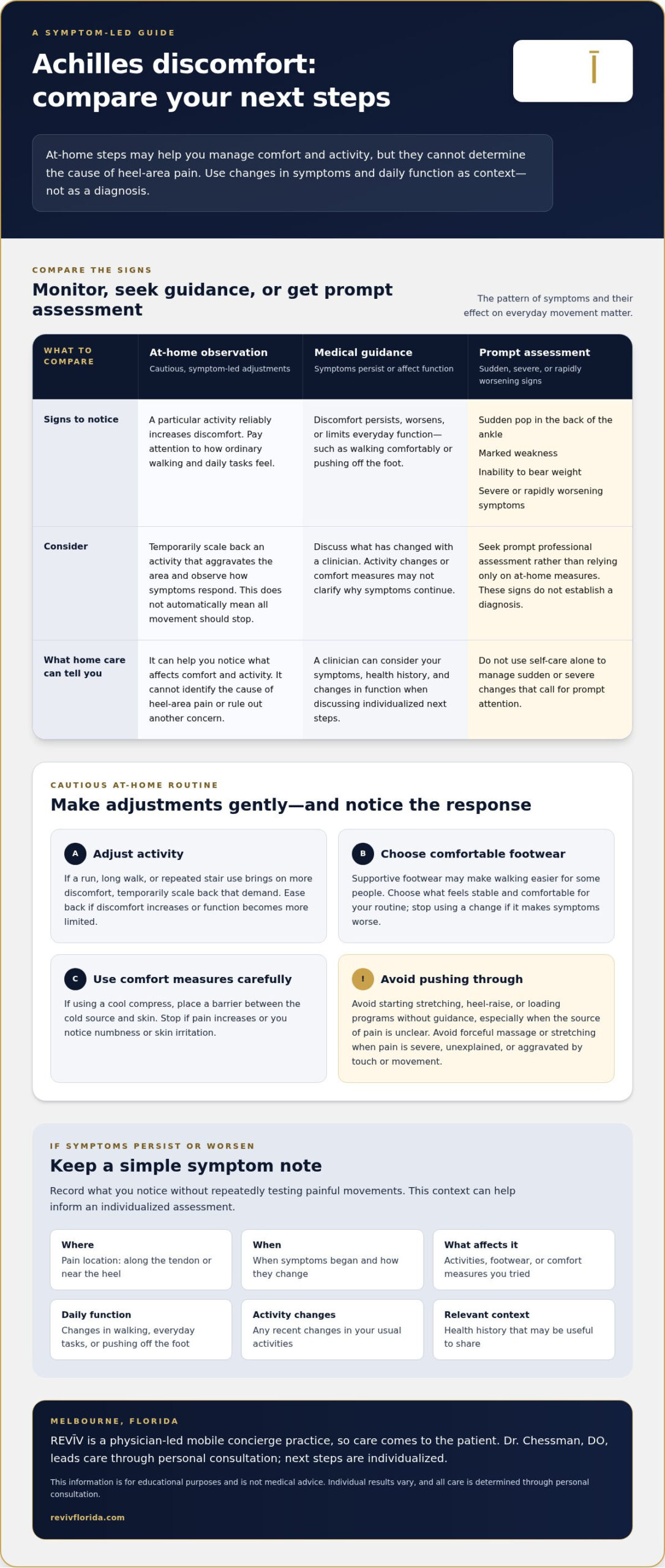
Changes in pain and function can help you decide whether to keep observing symptoms or seek medical guidance. Use the comparison below as a general orientation, not a diagnosis. A symptom pattern alone can’t identify the cause of heel-area pain or determine which care is suitable for you.
| What you notice | A cautious next step |
|---|---|
| Mild and improving: Discomfort is easing, and everyday movement remains manageable. | Continue to monitor how activity affects comfort and function. Keep adjustments gentle, and reconsider your approach if symptoms stop improving or begin to worsen. |
| Persistent or limiting: Symptoms continue, return with routine activity, or interfere with walking and daily tasks. | Arrange a medical discussion to review your symptoms and history. Ongoing limits deserve individualized attention, even without a sudden change. |
| Sudden or severe: You notice a sudden pop, pronounced weakness, major difficulty walking or bearing weight, notable swelling, or rapidly worsening pain. | Seek timely professional assessment rather than relying on home care alone. These signs don’t establish a diagnosis, but they should be evaluated promptly. |
This comparison can help organize your next step, but it can’t replace clinical evaluation or establish whether a particular approach is appropriate for you. If you’re unsure which category fits, consider how symptoms are changing and whether your ability to move comfortably is affected. It’s reasonable to seek guidance when the picture isn’t clear.
Which symptom changes should prompt timely assessment?
A sudden popping sensation, pronounced weakness, or major difficulty walking deserves prompt assessment. So do notable swelling or pain that is worsening quickly. Don’t test the area with forceful stretching, massage, or exercise. A clinician can assess the situation in context and advise on an appropriate next step.
When should persistent Achilles-area pain be discussed?
Discuss symptoms that continue, recur, or limit daily activities with a clinician, even if they developed gradually. Share where the discomfort occurs, when it began, what activity changes came before it, and how walking or other routines are affected. That history can guide an individualized conversation without assuming the cause in advance.
For people considering at-home treatment for achilles tendonitis Melbourne, self-care is a cautious starting point, not a reason to ignore changing symptoms. A private consultation with REVĪV’s physician-led team provides space to discuss your history, concerns, and goals. REVĪV is a mobile concierge practice serving Melbourne, Florida, with care that comes to the patient. Next steps are determined through personal consultation, and individual experiences vary.
Prepare for an Achilles Consultation: What to Track and Share
A few clear notes can make a conversation about heel-area discomfort more useful. You don’t need to identify the cause or use medical terms. Describe what you’ve noticed, what has changed, and what matters most in your daily routine. These details support a discussion; they don’t establish a diagnosis.
What symptom details can make a conversation more useful?
Before a consultation, jot down the main changes you’ve noticed. A brief record is enough. Consider including:
- Location: Where you feel discomfort, such as near the heel or higher along the back of the ankle.
- Onset and pattern: When it began, whether it followed a change in activity, and whether symptoms are improving, unchanged, or worsening.
- Triggers and ease: Which movements or activities seem to affect it, and whether anything brings comfort or increases discomfort.
- Function: How walking, stairs, standing, or usual daily tasks feel compared with your normal routine.
- Other observations: Any stiffness or swelling you’ve noticed, described plainly without trying to interpret what it means.
Also share recent changes in exercise or daily activity, any prior injuries, relevant health history, and care you’re currently receiving. Note self-care measures you’ve tried, including whether they seemed helpful, worsened symptoms, or made no noticeable difference. If your at-home treatment for achilles tendonitis Melbourne routine includes changing activity or footwear, record what changed and how you felt afterward. That context can help inform the conversation.
How to think about goals and next steps
Consider what you’d like to manage more comfortably. Your goal might be walking through a usual day, returning to a valued activity, or understanding what options may be appropriate. Specific, practical goals help make the conversation personal. You can also share concerns, expectations, and preferences about the care setting, including whether an in-home discussion would be convenient.
Recommendations depend on clinician assessment and individual circumstances. Be open about what you’ve tried, what you’re comfortable with, and what questions remain. No checklist can determine the cause of symptoms or guarantee that a particular approach is suitable. It can help you explain your experience and take part in a more informed, individualized discussion.
If you’d like to talk through your symptom notes, history, and goals in a private setting, learn about a private consultation with REVĪV’s physician-led clinical team. The mobile concierge practice brings care to the patient in Melbourne, Florida. Dr. Cheesman, DO, leads the clinical care described, and next steps are determined through personal consultation. Individual experiences vary.
Physician-Led In-Home Achilles Care in Melbourne
Home care can help you observe symptoms and make cautious adjustments, but uncertainty about what to do next may call for a personal conversation. REVĪV is a physician-led mobile concierge practice serving Melbourne, Florida. Its in-home model provides a private setting to discuss what you’ve noticed, how symptoms affect daily life, and what you hope to work toward.
A consultation is an opportunity to share relevant context and consider next steps with a clinical team. For people exploring at-home treatment for achilles tendonitis Melbourne options, the distinction matters: general self-care information can help you prepare questions, while recommendations need to be tailored to individual circumstances.
What to expect from a private, in-home consultation
Dr. Cheesman, DO, leads the clinical care described by REVĪV. In a private consultation, the clinical team can listen to your concerns and review relevant health history, current care, and your goals. You can explain which activities feel difficult, what you’ve already tried, and what questions you still have.
The discussion can focus on possible next steps based on your individual situation. If appropriate, non-surgical, regenerative-focused options may be discussed as approaches designed to support the body’s natural repair and recovery processes. Whether an option is suitable, and what potential benefits may be relevant, is determined through personal consultation. No specific approach or outcome is assumed in advance.
A personalized path forward, without promises
There isn’t one plan that fits everyone. Symptoms, health history, daily demands, and personal goals all help shape an individualized discussion. You might want to understand which care options could align with your circumstances or clarify what questions to raise as you consider next steps. Share your expectations openly; a thoughtful conversation includes both what you hope to do and what concerns you.
REVĪV’s mobile concierge model brings care to the patient, offering Melbourne residents an in-home setting for this conversation. Any potential benefits of regenerative-focused options are considered through consultation, and individual experiences vary. If sudden or severe symptoms need timely assessment, don’t rely on a concierge consultation as emergency care.
Learn about requesting a private consultation with REVĪV’s physician-led clinical team. You don’t need to arrive with a diagnosis or a predetermined plan. The purpose is to consider individualized next steps together, with clear expectations and your circumstances in view.
This information is for educational purposes and is not medical advice. Individual results vary, and all care is determined through personal consultation.
Take Your Next Step With Clarity
You don’t have to work out the cause of heel discomfort on your own before seeking guidance. Notes about your symptoms and any changes you’ve noticed can shape a more useful conversation about what matters to you and which questions remain. Let your next step be guided by your symptoms and priorities, rather than pressure to push through or find a one-size-fits-all answer.
For anyone weighing at-home treatment for achilles tendonitis Melbourne options, home care is a starting point, not a way to confirm what’s causing pain. If you’d value a thoughtful discussion about your circumstances, REVĪV offers private, individualized consultations. Recommendations and any potential benefits depend on personal assessment, and individual experiences vary.
Request a private consultation to discuss your symptoms, history, and goals with REVĪV’s physician-led clinical team. Care comes to the patient through the mobile concierge practice.
Frequently Asked Questions
Can I manage Achilles tendonitis at home?
Some mild symptoms may be managed initially with cautious activity changes and attention to how your foot responds. At-home treatment for achilles tendonitis Melbourne residents consider can’t confirm the cause of pain, however. Avoid pushing through worsening discomfort or starting a demanding exercise routine without guidance. If symptoms persist, limit everyday movement, or change suddenly, discuss them with a clinician rather than relying on home measures alone.
Should I keep walking if my Achilles tendon hurts?
It depends on how walking affects your symptoms and function. If a short, ordinary walk noticeably increases discomfort or changes your gait, reduce the demand and reassess rather than forcing yourself to continue. If walking remains comfortable, don’t treat that as proof that everything is fine. New difficulty bearing weight, pronounced weakness, or a sudden change calls for prompt medical assessment. A clinician can help you consider activity in light of your circumstances.
Is ice helpful for Achilles tendon pain?
A cool compress may offer temporary comfort for some people, but it won’t identify the cause of pain or suit every situation. If you try one, place fabric between the cold source and your skin, and stop if you notice numbness, irritation, or increased discomfort. Avoid using cold to mask pain so you can continue an activity that aggravates symptoms. Ask a clinician for personalized advice if you’re uncertain.
When should I seek medical attention for Achilles tendon symptoms?
Seek timely medical assessment for a sudden pop, marked weakness, major difficulty walking or bearing weight, notable swelling, or rapidly worsening pain. Persistent symptoms also deserve discussion if they interfere with daily activities, even without a sudden injury. A symptom checklist can help you explain what’s changed, but it can’t determine urgency for every person. If symptoms feel severe or are worsening quickly, don’t rely on home care alone.
How can I tell if Achilles tendon pain might be a rupture?
You can’t reliably confirm a rupture at home. A sudden popping sensation, pronounced weakness, swelling, or difficulty pushing off the foot or walking can be concerning and should prompt timely professional assessment. These signs don’t prove a rupture, and the absence of a pop doesn’t rule out a significant problem. Avoid testing the tendon with forceful movements. A clinician can assess your symptoms and decide what evaluation may be appropriate.
Can Achilles tendon symptoms improve without surgery?
Some Achilles-area symptoms may improve without surgery, but the right approach depends on what’s causing them and the person’s individual circumstances. Symptoms alone can’t determine whether surgery is needed or unnecessary. A clinician can discuss assessment findings and possible next steps, which may include non-surgical approaches when appropriate. Avoid assuming that a particular recovery path or timeline applies to everyone; individual experiences vary.
Does REVĪV offer in-home consultations in Melbourne, Florida?
Yes. REVĪV is a physician-led mobile concierge practice that brings in-home care to patients in Melbourne, Florida. Its service area also includes Orlando, Winter Park, Maitland, Altamonte Springs, Longwood, Casselberry, Orange City, DeLand, Deltona, Apopka, Oviedo, Winter Springs, Lake Mary, Sanford, Kissimmee, Winter Haven, Davenport, Titusville, Melbourne Beach, Lakeland, and Plant City. A consultation with Dr. Cheesman, DO, offers space to discuss symptoms, health history, and goals; next steps are individualized.
Disclaimer
For educational purposes only; not medical advice. Regenerative approaches
referenced are not FDA-approved to diagnose, treat, cure, or prevent any disease.
Individual results vary. Care is determined through individual consultation.
