
Regenerative Joint Pain Therapy in Orlando: Physician Guide
What if the first step toward easier movement isn’t choosing a therapy, but understanding what your joints and daily routine need? If you’re considering regenerative therapy for joint pain Orlando residents can explore through personalized, physician-led care, start with an individual assessment rather than a one-size-fits-all menu.
Joint discomfort can make familiar activities less comfortable, and traveling for an appointment may add another challenge. It’s reasonable to want a clear explanation of your options, their purpose, and their limits. Regenerative-focused therapies are designed to support the body’s natural repair and recovery processes. They aren’t appropriate for everyone, and individual results and experiences vary.
This guide explains how personal and clinical factors may shape an individualized plan, what an in-home consultation with REVĪV’s physician-led team in Orlando involves, and how care at home can make the first conversation more convenient. A private consultation is a calm, no-pressure way to discuss whether this approach may be appropriate for you. This information is educational, not medical advice. All care is determined through personal consultation.
Key Takeaways
- Use the movements and routines that matter to you as a starting point for a joint-pain conversation.
- Learn what regenerative-focused care is designed to support and why it isn’t automatically the right fit for everyone.
- Compare regenerative-focused options, conservative care, and surgical evaluation by their goals, clinical input, and practical considerations.
- Prepare for a personalized consultation by noting your symptoms, movement goals, and relevant health information.
- Explore how regenerative therapy for joint pain Orlando care may fit into an individualized plan through REVĪV’s in-home, physician-led consultation.
Joint Pain in Orlando: Start With What Movement Means to You
Joint discomfort can quietly reshape a day. You might take the stairs more slowly, shorten a walk, or hesitate before lifting a grocery bag. Over time, these adjustments can affect both movement and confidence in what your body can comfortably do.
A useful care conversation begins with your experience, not a list of therapies. This guide is for education, not diagnosis or a promise of results. A consultation about regenerative therapy for joint pain Orlando patients can have at home starts with the movements they want to do more comfortably. Whether a particular option is appropriate depends on an individual clinical assessment, and results and experiences vary.
Describe the joint-pain pattern, not just the location
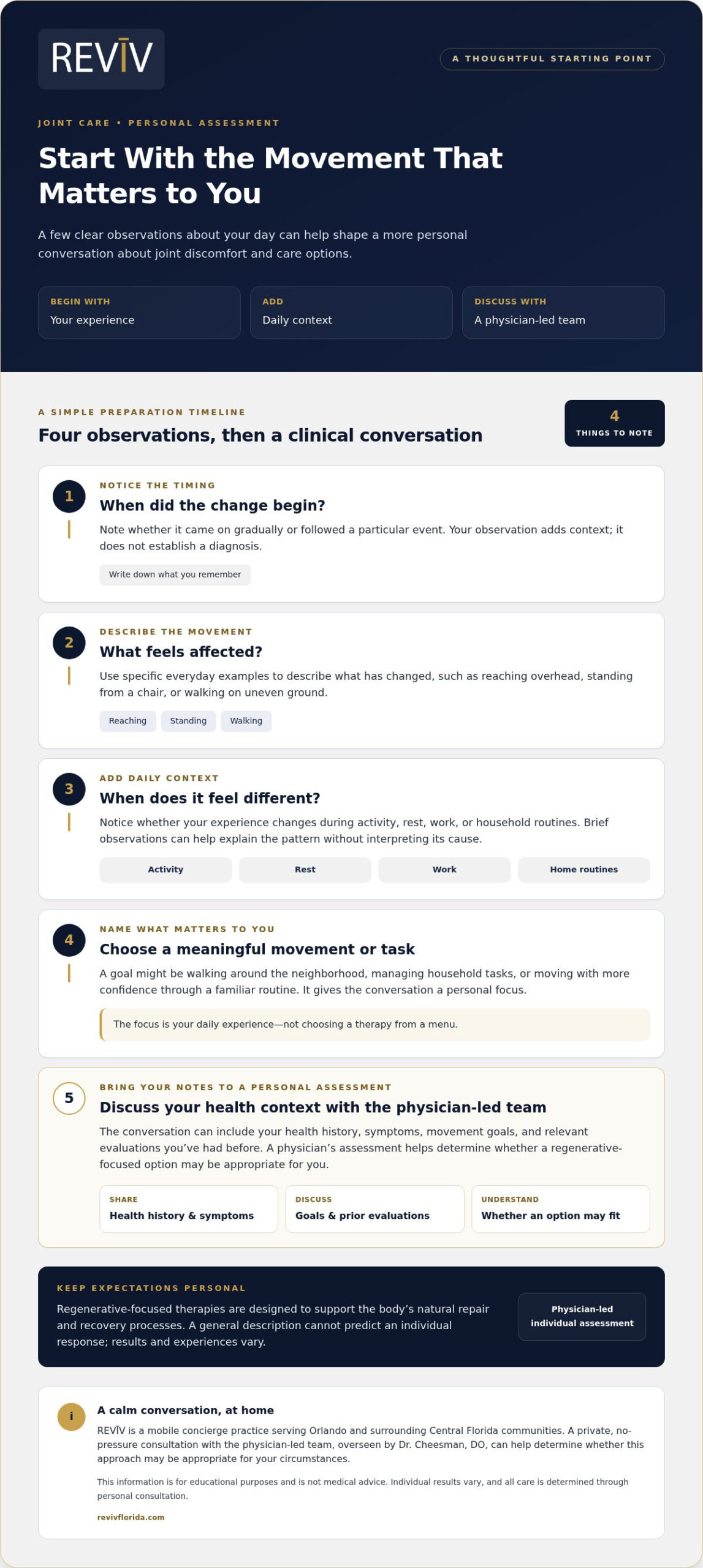
Before a consultation, note when the discomfort began and which movements seem to affect it. Does it feel different during work, at rest, or while doing routine tasks? A few brief observations can help you describe the pattern without trying to interpret its cause. These notes provide context, but they can’t establish a diagnosis. That requires an individual clinical assessment.
- When it began: Note whether the change was gradual or followed a particular event.
- What feels affected: Describe movements such as reaching overhead, standing from a chair, or walking on uneven ground.
- How it varies: Record whether it feels different during activity, rest, work, or household routines.
- What you want to do: Identify a meaningful movement or task you’d like to discuss.
Why function matters in an Orlando-area care conversation
“My knee hurts” names a location. “I’m changing how I walk the dog” adds daily context that can help shape a more personalized discussion. A mobility goal might be walking around the neighborhood, managing household tasks, or moving with more confidence through a familiar routine. These priorities keep the conversation focused on what matters to you.
REVĪV is a mobile concierge practice serving Orlando and surrounding Central Florida communities. The physician-led team brings in-home, non-surgical regenerative-focused care for spine and joint concerns, including the knees, shoulders, back, and hips. For readers comparing approaches, What is Regenerative Medicine? offers a broad introduction to the field; it doesn’t determine which care, if any, is suitable for an individual. If your concern centers on the knee, the guide to non-surgical knee-pain care offers more focused context.
Bring your observations and questions to a private consultation with the physician-led team, overseen by Dr. Cheesman, DO. An in-home conversation lets you discuss your movement goals and personal circumstances without traveling to a clinic. You can explore whether regenerative-focused care may fit your situation at your own pace. This information is for educational purposes and is not medical advice. Individual results vary, and all care is determined through personal consultation.
What Regenerative Therapy for Joint Pain Is Designed to Support
Regenerative-focused joint care is designed to support the body’s natural repair and recovery processes. Any specific option should be considered through an individualized clinical consultation.
That definition describes a general purpose, not a recommendation for everyone with joint discomfort. The phrase regenerative therapy for joint pain Orlando can refer to a conversation about non-surgical options, but it doesn’t tell you which approach may be appropriate, what to expect, or whether regenerative-focused care belongs in your plan. Those questions depend on your circumstances and a physician’s assessment.
The distinction matters. A general description can explain an approach’s intent, but it can’t predict how an individual will respond or establish that a particular option is suitable. A personalized plan should account for your health context and goals, rather than being selected from a menu based only on the location of discomfort.
How a physician-led assessment shapes the discussion
A physician-led conversation brings together your health history, the symptoms you’ve noticed, the activities you hope to do more comfortably, and relevant evaluations you’ve had before. Describing what has changed in daily life helps the clinical team understand your priorities alongside your medical background.
The assessment helps determine whether a regenerative-focused option may be appropriate for you. It also gives you a chance to ask questions and understand the reasoning behind an individualized recommendation. A general description of care, or another person’s experience, can’t replace this assessment.
Realistic expectations and individual variation
It’s reasonable to hope for more comfortable movement. That hope is a goal to discuss, not an outcome anyone can promise. Health histories, symptoms, and responses differ, so experiences and results vary from person to person. A consultation can clarify what an approach is designed to support in your situation without guaranteeing whether or when you’ll notice a change.
Keep the focus on informed decisions. Ask what an option is intended to support, how the recommendation relates to your goals, and what uncertainties matter in your circumstances. Clear answers distinguish potential aims, such as supporting mobility, from claims of a specific result. If an approach isn’t considered appropriate, that information can help you understand the next steps.
For people in Orlando and surrounding Central Florida communities, REVĪV’s mobile concierge model brings the consultation to the home. To discuss whether an individualized, in-home conversation is a suitable next step, you can request a private consultation. This information is for educational purposes and is not medical advice. Individual results vary, and all care is determined through personal consultation.
Comparing Joint-Pain Care Options in Orlando Without Assuming One Answer
Comparing care approaches is more useful when you start with your priorities, not a ranking of therapies. The discussion depends on what you hope to do more comfortably, your health history, and a clinician’s assessment. Regenerative therapy for joint pain Orlando residents may consider is one category of discussion, not an automatic first choice or a fit for everyone.
These categories serve different purposes. They aren’t interchangeable, and the table is a starting point for understanding the conversations, not a recommendation or substitute for individualized medical guidance.
| Care discussion | Possible goal | Clinical input | Practical considerations |
|---|---|---|---|
| Regenerative-focused options | Consider non-surgical care designed to support the body’s natural repair and recovery processes. | A physician considers personal history, symptoms, goals, and whether an option may be appropriate. | Suitability and individual experiences vary; a consultation helps clarify potential aims and limits. |
| Conservative care | Discuss non-surgical ways to support comfortable movement and daily function. | A clinician can consider current needs and how an approach fits the person’s circumstances. | Options and practical commitments vary; preferences and access may shape the conversation. |
| Surgical evaluation | Explore whether a surgical approach warrants consideration for an individual situation. | A qualified clinician evaluates relevant health factors and discusses whether further assessment is appropriate. | This is an evaluation conversation, not a commitment to a procedure. |
Questions that make a comparison more useful
Before weighing options, identify the movement or routine you most want to preserve or improve. Then separate practical considerations, such as convenience or the nature of a care approach, from clinical questions about suitability, potential benefits, and limitations. A physician can discuss the clinical considerations after a personal assessment; preference alone can’t establish which option is appropriate.
- What activity would you most like to approach with greater comfort?
- Which practical factors matter to you as you consider care?
- What would you like the clinician to explain about the purpose and limits of an option?
When the discussion may need a different direction
This educational comparison can’t identify the cause of symptoms or determine how urgent they are. Seek prompt medical attention for sudden, severe symptoms or a new serious injury. Regenerative-focused care isn’t a substitute for every other form of care. The appropriate next step depends on clinical assessment, and the conversation may point in a different direction.
A balanced comparison leaves room for more than one path. The aim is not to choose a category in advance, but to understand your priorities and discuss which options, if any, fit your individual circumstances.
Prepare for a Personalized Joint-Pain Consultation at Home
A little preparation can make a consultation more focused. You don’t need to arrive with a diagnosis or decide in advance which care option you want. Notes about your symptoms, daily activities, and questions can help the physician-led team understand what matters to you and guide a personalized conversation.
Think of your notes as context, not a checklist you must complete perfectly. They support discussion but don’t determine a recommendation. What may be appropriate depends on individual assessment.
What to write down before the conversation
Keep it simple. A short note on your phone or a few lines on paper can help you remember details during the discussion. Include what best reflects your experience, even if some details are uncertain.
- Affected joints: Note which areas feel uncomfortable and whether more than one joint is involved.
- Symptom pattern: Record when you first noticed a change, what movements seem to affect it, and how it varies during activity or rest.
- Everyday impact: Describe tasks or routines that feel limited, such as standing from a chair, reaching, walking, or completing household activities.
- Relevant history: Gather health-history details and information from prior evaluations, if available. You don’t need to interpret them; they can provide useful background.
- Your questions and preferences: Note what you hope to understand, what feels uncertain, and any practical considerations that matter as you explore care.
If you can’t answer every point, that’s fine. The purpose is to help you describe what you’ve noticed, not to assess yourself or reach a conclusion before speaking with a clinician.
What to expect from a mobile concierge visit
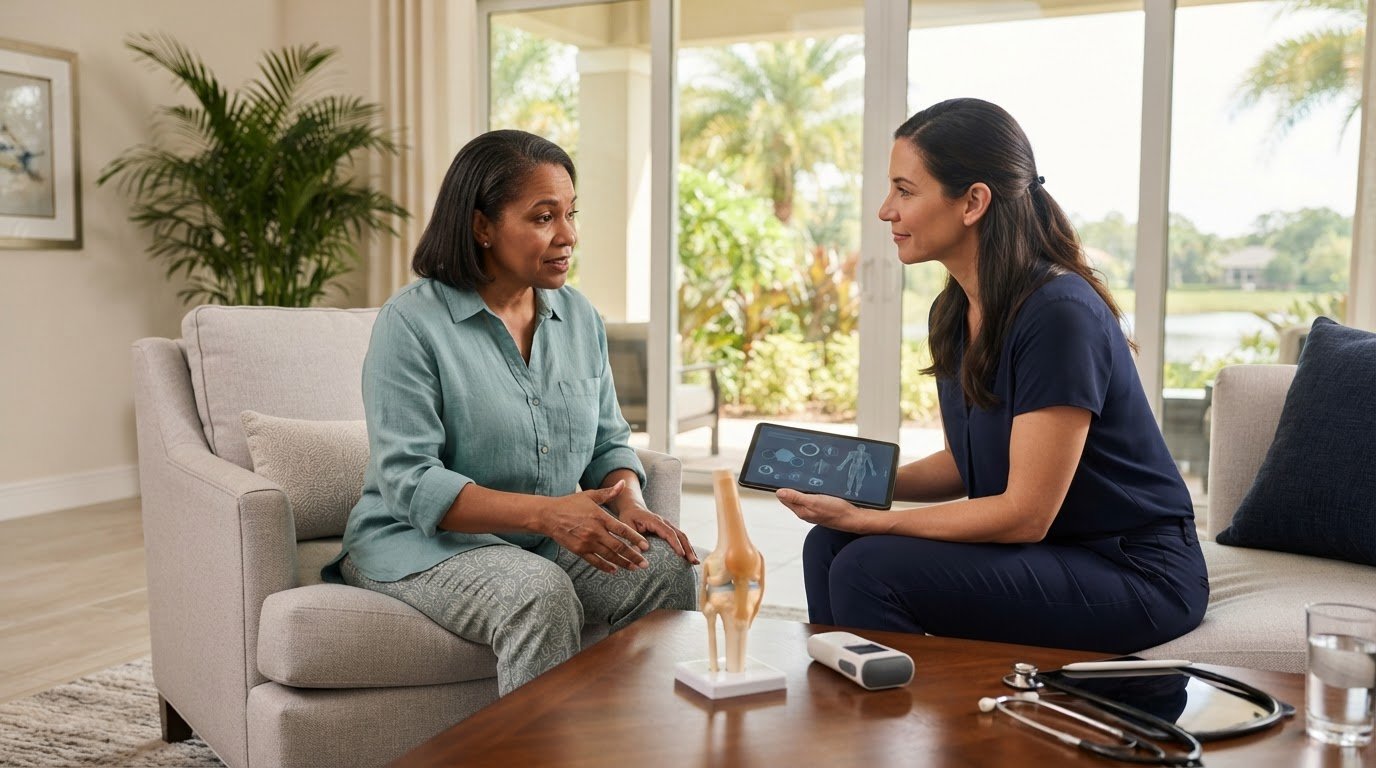
REVĪV brings physician-led, regenerative-focused care to patients’ homes. The in-home setting offers a convenient place to discuss your concerns and goals without traveling to a clinic. The conversation is consultative: the clinical team considers your individual circumstances and whether a non-surgical option may be appropriate.
Use your notes to guide the discussion, ask how a recommendation relates to your priorities, and raise questions about its purpose and limits. An assessment may inform next steps, but preparation doesn’t guarantee a particular recommendation or outcome. Each plan is individualized, and experiences vary.
If you’re ready to discuss your situation in a calm, one-to-one setting, request a private consultation. You can begin with the questions you have today and explore the next step without pressure.
REVĪV’s In-Home Regenerative Joint Care in Orlando
Care can begin in a familiar place: your home. REVĪV is a physician-led mobile concierge practice serving Orlando and surrounding Central Florida communities. The team brings non-surgical, regenerative-focused care to patients at home rather than asking them to travel to a fixed clinic. For someone whose joint discomfort makes getting around less convenient, an in-home conversation offers a way to discuss personal goals and clinical questions.
The focus isn’t on choosing a therapy from a menu. It’s on understanding your circumstances and determining through personal consultation whether regenerative-focused care may be appropriate. These therapies are designed to support the body’s natural repair and recovery processes. Potential goals, such as supporting comfortable movement, are topics for individualized discussion, not promised outcomes. Results and experiences vary.
Care that comes to you across the Orlando area
Orlando life can involve different routines from one neighborhood to the next. Walking around your community, managing household responsibilities, or heading toward nearby Winter Park or Maitland may bring different movement priorities into focus. REVĪV’s mobile concierge model brings the care conversation to patients’ homes in Orlando and surrounding communities, without requiring a trip to a clinic.
An in-home setting can make it easier to discuss how joint discomfort affects your surroundings and routines. The physician-led team can listen to what you’d like to do more comfortably, review relevant clinical context, and discuss whether a tailored approach is suitable. The overview of mobile regenerative medicine in Orlando provides more context about this care model.
A thoughtful next step with the physician-led team
Clinical care is overseen by Dr. Cheesman, DO, and a physician-led clinical team. A private consultation is an opportunity to share your concerns, ask about the purpose and limits of regenerative-focused options, and hear whether an individualized plan may be appropriate. The conversation doesn’t commit you to a particular recommendation. It gives you space to consider your options with clinical guidance.
If you’re considering regenerative therapy for joint pain Orlando care delivered at home offers a convenient way to begin the discussion. You can request a private consultation when you’re ready, without pressure to pursue a specific option. Appropriate care is determined through personal consultation, and individual results vary.
This information is for educational purposes and is not medical advice. Individual results vary, and all care is determined through personal consultation.
Begin With a Conversation About the Movement That Matters
You don’t need to arrive with a decision about care. Start with the movement you hope to approach differently and the questions you still have. A personal consultation can help clarify whether regenerative therapy for joint pain Orlando care may be appropriate for your circumstances, with potential goals discussed as possibilities rather than promises.
REVĪV’s physician-led clinical care, overseen by Dr. Cheesman, DO, brings the conversation to your home through a mobile concierge practice serving Orlando and surrounding Central Florida communities. Recommendations are based on individual consultation, and experiences vary. The next step can simply be a thoughtful exchange about your priorities, your health context, and which options may fit.
If you’d like to explore that conversation at your own pace, request a private consultation. A clear, personalized discussion can help you consider your path forward with greater confidence.
Frequently Asked Questions
Is regenerative therapy appropriate for every kind of joint pain?
No. Regenerative-focused care isn’t appropriate for every kind of joint discomfort, and a symptom description alone can’t establish suitability. A physician may consider whether symptoms followed an injury, how they affect function, your health history, and any prior findings. If another kind of evaluation or care conversation is more suitable, that can be discussed instead. Individual experiences and results vary; personal consultation guides an individualized recommendation.
Can regenerative-focused care be discussed at home in Orlando?
Yes. REVĪV is a mobile concierge practice, so a consultation can take place in the patient’s home rather than at a walk-in clinic. People considering regenerative therapy for joint pain Orlando can discuss symptoms and goals with the physician-led team. The local service area includes Orlando, Winter Park, Maitland, Altamonte Springs, Longwood, Casselberry, Orange City, DeLand, Deltona, Apopka, Oviedo, Winter Springs, Lake Mary, Sanford, Kissimmee, Winter Haven, Davenport, Titusville, Melbourne, and Melbourne Beach.
How does a physician determine whether regenerative-focused care may be suitable?
A physician considers your circumstances, not just which joint feels uncomfortable. Be ready to describe how symptoms affect function, share relevant health history, and bring prior evaluation notes if you have them. A concise list of current medicines and supplements can also provide useful context. The clinician uses this information to discuss whether an option may be suitable for you; it doesn’t predetermine a recommendation.
What should I bring up during a joint-pain consultation?
Bring questions that help clarify the decision, such as, “What is this option intended to support in my situation?” and “What factors could make it suitable or unsuitable?” You can also raise practical preferences, including concerns about travel or the time involved in care. A focused question list can keep the conversation useful, even if you don’t have every prior record available.
Does non-surgical regenerative-focused care guarantee that I can avoid surgery?
No. Choosing a non-surgical approach can’t guarantee that surgery will never be considered. Whether it belongs in a person’s care discussion depends on their clinical circumstances and physician assessment. A consultation can help clarify appropriate next steps, including whether a different kind of evaluation should be discussed. No specific outcome is promised, and individual experiences and results vary.
Is an in-home consultation a substitute for emergency care?
No. A mobile concierge consultation isn’t emergency medical care. Sudden severe symptoms, a serious new injury, or another urgent medical concern should be addressed through appropriate emergency care. For non-emergency questions about ongoing joint discomfort, a personal consultation offers an opportunity to discuss your goals and possible next steps. This information is educational and isn’t medical advice.
Disclaimer
For educational purposes only; not medical advice. Regenerative approaches
referenced are not FDA-approved to diagnose, treat, cure, or prevent any disease.
Individual results vary. Care is determined through individual consultation.
