

Long-Term Side Effects of Pain Medication: What to Know
Could the long term side effects of pain medication depend on more than how long you’ve been taking it? Yes. It’s understandable to have questions about ongoing medication, especially if a new symptom appears or you’re worried that raising a concern could put your pain support at risk.
Risks vary by medication, dose, duration, and personal health factors. This article explains how potential effects differ among opioids, nonsteroidal anti-inflammatory drugs such as ibuprofen, and acetaminophen. It also offers practical ways to prepare for a medication review and discuss concerns without stopping a prescribed medicine abruptly.
If you’d like to explore additional options, a personalized consultation with REVĪV’s physician-led clinical team can include a discussion of non-surgical, regenerative-focused care alongside your existing plan. REVĪV is a mobile concierge practice serving Central Florida, with care delivered in the patient’s home. Individual experiences vary. This information is for educational purposes and is not medical advice. Individual results vary, and all care is determined through personal consultation.
Key Takeaways
- The long term side effects of pain medication vary by medication class, dose, duration, and personal health factors. There is no single timeline or risk profile for everyone.
- Opioids, NSAIDs, and acetaminophen have different potential concerns. Discuss which ones may be relevant to your health and current medicines.
- A medication review should consider possible side effects alongside pain relief, daily function, and what matters most to you.
- Keep notes on symptoms and medicines to support a focused conversation with your prescriber. Don’t stop, taper, combine, or change doses without qualified guidance.
- A personalized REVĪV consultation can help you explore non-surgical, regenerative-focused options alongside your existing plan. Individual experiences vary.
What long-term side effects of pain medication can mean for you
“Long-term use” has no universal time limit. Taking a medicine regularly over an extended period may raise different questions than taking it occasionally, but how to assess those questions depends on the medicine and the person taking it. The phrase long term side effects of pain medication covers a range of possible effects. It doesn’t mean that everyone who uses pain relief will experience harm.
It helps to distinguish a possible side effect from your individual risk. A side effect is an effect that may occur with a medicine. A personal risk assessment considers how relevant that effect may be for you, based on your health, dose, other medicines, and reasons for taking it. A symptom that begins while you’re taking a medicine may be related, but timing alone can’t establish the cause. Share changes with your clinician rather than trying to determine the cause on your own.
Why the medication type changes the risk picture
Pain medicines work in different ways. Opioids act on pain pathways in the nervous system. NSAIDs, such as ibuprofen or naproxen, reduce inflammation. Acetaminophen works differently and is commonly used for pain or fever. Their possible effects and precautions aren’t interchangeable, and medicines within the same class can differ. For a broad overview of opioid effects, including tolerance and physical dependence, see this overview of opioids, then discuss your specific prescription with a clinician.
Risk factors that can shape an individual experience
The dose, how often you take a medicine, and how long you’ve used it can all matter. So can other prescriptions, over-the-counter medicines, or supplements. Health history is relevant, too. For example, existing kidney, liver, heart, or digestive concerns may affect which risks a clinician considers, depending on the medicine. Age can also shape decisions, including attention to balance, alertness, and the possibility of falls. These factors don’t determine what will happen, but they can help guide a personalized review.
Put possible effects in context
A symptom isn’t automatically a medication side effect, and a known risk doesn’t mean it will happen to you. Your clinician can consider when the symptom started, how it has changed, your medication routine, and other possible explanations. A simple record of medicines, doses, symptoms, and timing can make that conversation more specific.
Medication risks depend on the drug, dose, duration, and your health, so review them in the context of your individual situation. If you’re concerned, contact the clinician who prescribed the medicine and ask for a review. Don’t stop, taper, combine, or change a prescribed medication on your own. You can discuss additional options as part of a broader conversation without stopping your current medication.
How long-term effects differ across common pain medication classes
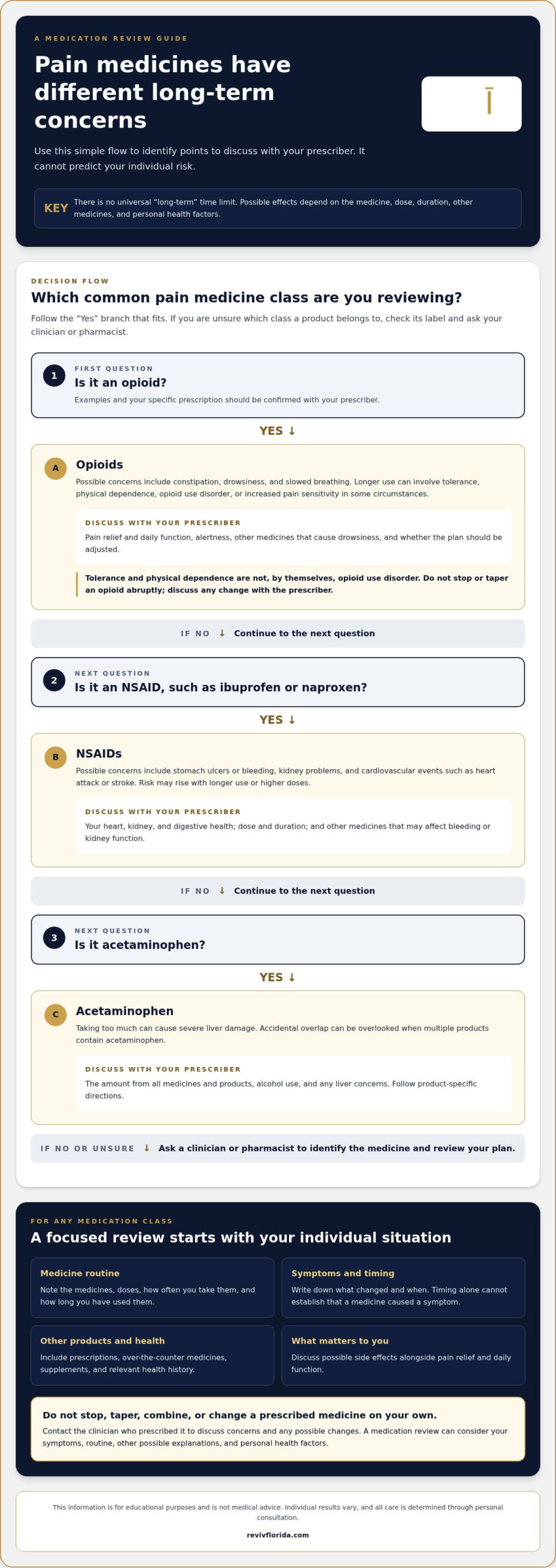
The possible long term side effects of pain medication depend partly on which medicine you take. Opioids, nonsteroidal anti-inflammatory drugs (NSAIDs), and acetaminophen have different cautions. Use the comparison below to prepare for a conversation with your clinician, not to predict what will happen to you. Medicines within the same class can also differ, and your dose, health history, and other medicines matter.
| Medication class | Possible concerns with ongoing use | Points to review with your clinician |
|---|---|---|
| Opioids | May cause constipation, drowsiness, and slowed breathing. Longer use can involve tolerance, physical dependence, opioid use disorder, or increased pain sensitivity in some circumstances. | Review pain relief and daily function, alertness, other medicines that cause drowsiness, and whether the plan should be adjusted. |
| NSAIDs, such as ibuprofen or naproxen | May increase the risk of stomach ulcers or bleeding, kidney problems, and cardiovascular events such as heart attack or stroke. Risk may rise with longer use or higher doses. | Discuss your heart, kidney, and digestive health, dose and duration, and other medicines that may affect bleeding or kidney function. |
| Acetaminophen | Taking too much can cause severe liver damage. The risk can be overlooked when multiple products contain acetaminophen. | Review the amount from all medicines and products, alcohol use, and any liver concerns. Follow product-specific directions. |
Opioids: distinguish dependence from opioid use disorder
With regular opioid use, the body may adapt. Tolerance means the same dose may have less effect over time. Physical dependence means withdrawal symptoms can occur if the medicine is reduced or stopped suddenly. Neither alone means a person has opioid use disorder, which involves a problematic pattern of use and requires clinical assessment. Opioids can also cause sedation and, in some situations, dangerously slowed breathing. Don’t stop or taper one abruptly; discuss any change with the prescriber.
NSAIDs and acetaminophen: different cautions
The FDA warns that NSAIDs may raise the risk of serious cardiovascular events and gastrointestinal bleeding or ulcers. Kidney concerns also matter, especially for people with relevant health risks. Acetaminophen has a different central caution: too much, including an accidental overlap across combination products, can seriously harm the liver. Read active ingredients and ask a clinician or pharmacist how guidance applies to your specific products and health history. No class is universally safest for everyone.
A medication review can help clarify which concerns apply and whether the balance of relief, function, and potential risk still fits your priorities. If you’d also like to discuss individualized, non-surgical, regenerative-focused options alongside prescribed care, a private consultation with REVĪV’s clinical team can be part of that conversation. Exploring options doesn’t mean stopping medication. Individual experiences vary.
How to weigh medication concerns against pain and daily function
A medication decision isn’t simply a choice between “good” and “bad.” A more useful question is whether the current plan’s relief and support for daily function still make sense alongside possible side effects and your priorities. The long term side effects of pain medication are one part of that discussion, not the only measure of whether a plan is right for you.
Think about what you want to be able to do, such as sleep more comfortably, walk around the home, manage daily tasks, or take part in activities that matter to you. Consider whether the medicine seems to support those goals, what unwanted effects you’ve noticed, and which trade-offs feel acceptable. A clinician can help weigh these points in context instead of relying on a general warning alone.
Make a medication review specific
Before an appointment, gather details that can help your clinician understand your experience. A written list or notes on your phone are enough. Include:
- Each medicine’s name, dose, schedule, and how long you’ve been taking it.
- Any changes you’ve noticed, when they began, and whether they affect daily activities.
- Other prescriptions, over-the-counter products, and supplements you use.
- What you hope to do more comfortably and how well the current plan supports that goal.
These details can help distinguish a review of potential risks from a decision to start, stop, taper, or change treatment. Those are separate clinical decisions. Don’t adjust a prescribed medicine on your own; ask the prescriber to guide any change.
Know when to seek prompt help
Some symptoms need urgent attention. If someone taking medication is difficult to wake, unresponsive, or having trouble breathing, contact local emergency services immediately. Severe chest pain or signs of a serious allergic reaction, such as swelling of the face or throat with difficulty breathing, also warrant emergency care.
For new or worsening symptoms that don’t appear to be an emergency, contact the prescribing clinician promptly. Describe what changed, when it started, and which medicines or products were taken. Don’t wait for a routine medication review if a symptom is becoming more concerning.
Medication decisions should account for relief, function, possible risks, and personal goals. If pain affects your knee, an individualized discussion can include learning about non-surgical knee pain options. Exploring non-surgical, regenerative-focused options through a personal consultation doesn’t mean stopping prescribed medication. Any potential benefits depend on the individual, and experiences vary.
Concerns about long-term pain medication
Concern is a good reason to start a conversation, not to make a sudden change on your own. A clear plan can help you understand which risks may apply, whether monitoring is appropriate, and what options fit your needs. Use these steps to prepare and keep the discussion focused.
- Document what concerns you. Note the medicine, dose, schedule, and how long you’ve taken it. Record symptoms and when they occur, along with any effect on sleep, movement, or daily tasks. Include what the medication seems to help, too.
- Contact the prescribing clinician. Explain what you’ve noticed and ask for a medication review. Bring the medicine packaging or an accurate, up-to-date list so the clinician can see the exact products and strengths.
- Review the options together. Ask about potential side effects, whether monitoring is appropriate, what alternatives may be considered, and which changes or symptoms should prompt follow-up.
- Follow the agreed plan. Keep track of next steps and who to contact with questions. Don’t stop, taper, combine, or change doses without qualified guidance.
Prepare for a clear conversation with your prescribing clinician
A short, organized record can make an appointment more useful. Include all prescriptions, nonprescription medicines, and supplements, along with known allergies and relevant health history. If a symptom comes and goes, note its timing and what was happening around it. You might also write down which activities have become easier or harder. This connects the medication discussion to your goals, not only to a list of possible risks.
Consider asking: “What should I watch for?” “How will we know whether this plan is helping?” and “If we decide to change something, how should that happen?” Medication changes should be planned with the prescriber, not made abruptly or based on someone else’s experience. The right approach depends on your circumstances and the medicine involved.
Explore options without making abrupt changes
Discussing other approaches doesn’t require stopping prescribed medication. Non-pharmaceutical options may be considered alongside existing medical care, with decisions tailored to your health, priorities, and current plan. For an educational overview of in-home regenerative medicine in Orlando, learn how a physician-led consultation can frame individualized, non-surgical, regenerative-focused options. Discuss any potential benefits in a personal consultation, as individual experiences vary.
If you’d like to explore whether an individualized consultation could support your next steps, you can request a private consultation. The conversation can focus on options alongside your current care, not on stopping medication.
How a personalized REVĪV consultation can support informed next steps
Understanding possible medication risks is one part of a broader conversation about your health, daily function, and priorities. REVĪV is a physician-led mobile concierge practice serving Central Florida, with care delivered in the patient’s home. The clinical team can discuss personalized, non-surgical, regenerative-focused options as an additional topic to consider alongside your existing medical care.
These options are designed to support the body’s natural repair and recovery processes. Whether they may be appropriate depends on your circumstances and is considered through personal consultation. A conversation gives you an opportunity to ask questions and understand possible next steps. It isn’t a promise of a particular result or a direction to stop prescribed medication.
What an individualized consultation can help clarify
You can share what concerns you about the long term side effects of pain medication, what you hope to do more comfortably, and how your current plan fits into daily life. Relevant health context, past experiences, and personal goals can inform a thoughtful discussion. Bring questions, too. For example, you might want to understand what non-surgical options involve or how a regenerative-focused approach could fit alongside care you already receive.
The clinical team can discuss whether an option may be appropriate to consider based on your individual situation. This conversation is distinct from decisions about prescribing, reducing, or stopping medication. Those decisions remain with the clinician who prescribes your medicine. If you’re considering another approach, let your prescriber know so your care can be coordinated. Potential benefits depend on individual circumstances, and experiences vary.
A private, at-home conversation without pressure
With a mobile concierge model, care comes to you at home. This can make it easier to have a focused conversation in a familiar setting and discuss questions at a comfortable pace. If nerve-related concerns are part of your experience, you can also read about neuropathy care in Orlando as you consider what you’d like to ask.
Before a consultation, consider writing down your goals and questions. You might also bring an accurate medication list so the discussion reflects your current care. The purpose is to explore whether personalized, regenerative-focused options may fit your circumstances, not to replace your prescribing clinician or change your medication plan during the conversation.
If you’d like to explore individualized, non-surgical options with REVĪV’s physician-led clinical team, you’re welcome to request a private consultation. There’s no need to make medication changes before speaking with your prescriber. Your next steps can be considered thoughtfully, with your existing care and personal goals in view.
Take the next step at your own pace
Questions about the long term side effects of pain medication don’t need to be answered all at once. Start with an open conversation about what matters most to you and what you’d like to understand better. Thoughtful decisions can take time, and raising a concern doesn’t mean you have to give up support for your pain.
If you’re interested in exploring additional possibilities, REVĪV’s clinical team can discuss whether personalized, non-surgical, regenerative-focused options may fit your circumstances. Potential benefits are considered through an individual consultation, and experiences vary. Medication decisions remain with your prescribing clinician, so keep them involved in any changes to your care.
Request a private consultation with REVĪV to discuss your questions and possible next steps without pressure. A calm, informed conversation can help you move forward with greater clarity.
Frequently Asked Questions
Can long-term pain medication affect your kidneys or liver?
Yes, some medicines may affect the kidneys or liver, but the concerns differ by medication. NSAIDs such as ibuprofen can pose kidney risks, while taking too much acetaminophen can cause serious liver harm. Your personal risk depends on factors such as health history and other medicines. A clinician can review your products and decide whether monitoring or precautions are appropriate. Don’t assume a symptom identifies which organ, if any, is affected.
Can you become dependent on pain medication without being addicted?
Yes. Physical dependence can occur as the body adapts to a medicine, and stopping suddenly may cause withdrawal. That alone doesn’t mean someone has opioid use disorder, which involves a problematic pattern of use assessed by a clinician. Dependence is a medical response, not a personal failing. If you’re concerned about your use or feel unable to control it, speak openly with a healthcare professional for supportive guidance.
Is it safe to take over-the-counter pain medicine with a prescription?
It depends on the exact products and your health, so check with a clinician or pharmacist before combining them. An over-the-counter medicine may contain the same active ingredient as a prescription combination product, leading to accidental excess. NSAIDs can also interact with some medicines, including those that affect bleeding, while sedating medicines taken with opioids may increase drowsiness or breathing risks. Bring the packaging or a complete list for review.
What happens if you stop taking pain medication suddenly?
The effects vary by medicine, dose, and how long you’ve taken it. Some people may have withdrawal symptoms, a return of pain, or other changes if they stop abruptly. For certain medicines, a prescriber may recommend a gradual, individualized plan. Don’t create a taper yourself or skip doses to test how you feel. Contact the prescribing clinician before making a change, and seek urgent help for severe or alarming symptoms.
Can long-term pain medication affect memory or concentration?
Some medicines, particularly opioids and other drugs that cause drowsiness, may affect alertness, attention, or clear thinking. The effect can also depend on combinations, sleep, and health factors, so a new lapse doesn’t establish the cause. Tell your clinician when it began and whether it affects tasks such as driving or following instructions. Sudden severe confusion or difficulty waking someone needs urgent medical attention.
How do you know whether a symptom is a medication side effect?
You can’t reliably tell from timing alone, since a symptom may have more than one cause. Keep a brief record of when it occurs, when you take each medicine, and whether anything seems to change it. This can help your prescriber assess whether the long term side effects of pain medication could be relevant and decide what to review. Seek urgent care for severe symptoms rather than waiting to complete a diary.
Are non-pharmaceutical options worth discussing for ongoing pain?
Yes, they may be worth discussing as individualized possibilities alongside your current care, not as automatic replacements for medication. A consultation with REVĪV’s physician-led team can explore whether non-surgical, regenerative-focused options fit your goals. Potential benefits depend on personal circumstances, and experiences vary. REVĪV provides mobile concierge care in Orlando, Winter Park, Maitland, Altamonte Springs, Longwood, Casselberry, Orange City, DeLand, Deltona, Apopka, Oviedo, Winter Springs, Lake Mary, Sanford, Kissimmee, Winter Haven, Davenport, Titusville, Melbourne, and Melbourne Beach.
Disclaimer
For educational purposes only; not medical advice. Regenerative approaches
referenced are not FDA-approved to diagnose, treat, cure, or prevent any disease.
Individual results vary. Care is determined through individual consultation.
