

Getting My Life Back from Neuropathy Pain: A Thoughtful Path Forward
What if getting my life back from neuropathy pain starts not with a sweeping promise, but with one practical change in daily life? Pain, tingling, or numbness can interrupt sleep, movement, and familiar routines. It’s understandable to want relief while also wondering which options fit your circumstances and what improvement might realistically mean for you.
A thoughtful path begins with clarity. This guide can help you identify goals for daily function, prepare to discuss your symptoms and options with a physician-led team, and consider supportive care with realistic expectations. Progress looks different for each person, so a useful plan should reflect your priorities, health history, and individual needs.
At REVĪV, Dr. Cheesman, DO, leads personalized, regenerative-focused care through a mobile concierge practice that brings in-home consultations to patients across Central Florida. A conversation in your own home gives you space to discuss what you’re experiencing and explore whether options designed to support the body’s natural repair and recovery processes may be appropriate. Individual experiences and results vary, and all care is determined through personal consultation. This information is for educational purposes and is not medical advice.
Key Takeaways
- Define what “getting my life back from neuropathy pain” means to you by choosing a daily activity that matters personally.
- Track how symptoms affect that activity, then bring your observations and questions to a clinician.
- Compare support options by their purpose, clinician involvement, and fit with your circumstances, not by promises of specific results.
- Build a practical plan around your priorities and revisit it based on your experience.
- Learn how an in-home consultation with REVĪV’s physician-led team may help you explore personalized, regenerative-focused support in Central Florida.
When Neuropathy Pain Changes Daily Life, Start With What Matters Most
Neuropathy-related pain or altered sensation can make familiar routines feel different. Discomfort might interrupt sleep, tingling might draw your attention while walking, or numbness might make everyday tasks less comfortable. Symptoms vary, and there’s no single experience you need to match.
“Neuropathy is a term for problems involving the nerves that carry messages between the body and the brain.” The word describes a broad range of nerve-related concerns, not one specific cause or personal diagnosis. A general overview of Peripheral Neuropathy can provide background, but an online description can’t determine what’s behind your symptoms.
Describe the changes you notice in everyday life
Before comparing options, make a clear record of what has changed. A brief note on your phone or in a notebook can help you describe the experience without trying to explain its cause. Record what you feel, when you notice it, what you were doing, and which activities were affected. Include sleep disruptions and everyday tasks, such as walking around the house or preparing a meal, if they’re relevant to you.
- Sensation: Describe what you notice in your own words, such as burning, tingling, numbness, or sensitivity.
- Timing: Note when it occurs and whether it changes during the day or at night.
- Context: Record what you were doing and any patterns you’ve noticed, without assuming a trigger.
- Daily impact: Note which activity, rest, or routine was interrupted or changed.
This record isn’t a diagnostic tool. It can help a clinician understand your concerns and ask focused questions. Keep observations separate from conclusions: “my feet feel numb after I’ve been standing” describes an experience, but it doesn’t establish why it happens.
Set goals around function, not guarantees
Getting my life back from neuropathy pain doesn’t have to mean expecting every sensation to disappear. It can mean identifying what you’d most like to protect or make easier in your day. Choose one or two activities that matter to you, such as resting more comfortably, taking a short walk, or completing a household task with greater ease. Your priorities are personal, not a universal checklist.
Use those activities as conversation goals, not predictions about what any option will achieve. A clinician can consider your symptoms, health history, and priorities when discussing next steps. For more background on individualized, regenerative-focused support, explore the neuropathy care overview. Any potential benefits depend on personal consultation, and individual experiences vary.
Understand Your Symptoms Before Comparing Neuropathy Support Options
Before weighing support options, consider what you’re experiencing and what remains unknown. Neuropathy describes nerve-related problems, but it doesn’t point to one cause or one predictable pattern. Symptoms, health history, and daily effects differ from person to person. An online description may offer background, but it can’t establish what’s happening in your situation.
A symptom tells you what you feel; it doesn’t identify the underlying cause. Tingling, numbness, burning sensations, or changes in comfort are observations to share, not conclusions about why they occur. The Peripheral Neuropathy Information from NINDS offers general background on symptoms, possible causes, and diagnosis. Your own history needs to be considered in context by a clinician.
Bring a clear account of symptoms to a consultation
Simple notes can help you use a consultation well. Record when you first noticed a change, where you feel it, whether it has shifted over time, and how it affects your routines. Include what you’ve already discussed with clinicians and what questions remain. The goal isn’t to diagnose yourself. It’s to make your experience easier to explain.
- Symptom history: Note when changes began, where they occur, and what they feel like.
- Daily impact: Describe how symptoms affect movement, rest, or specific activities that matter to you.
- Health context: List existing diagnoses, medications, supplements, and relevant care history.
- Questions: Write down what you’d like clarified, including which next steps may fit your circumstances.
Bring your list as it is, even if some details are uncertain. A physician-led clinical conversation can consider your account, relevant health history, and personal priorities when discussing options. Don’t stop or change a prescribed medication based on an online list or article; speak with the clinician who prescribed it.
Know when symptoms need urgent attention
Some changes call for prompt attention rather than a scheduled conversation. Seek urgent medical assessment for sudden, severe symptoms or new weakness. If you believe you’re facing an emergency, contact local emergency services. REVĪV isn’t an emergency provider, and an in-home consultation isn’t a substitute for urgent assessment.
If you’re considering getting my life back from neuropathy pain, begin with an accurate account of what has changed rather than an assumption about its cause. A private consultation with REVĪV’s physician-led team offers a setting to discuss your symptoms and priorities and explore whether personalized, regenerative-focused support may be appropriate. Individual experiences and potential benefits vary.
Compare Neuropathy Support Options With Realistic Expectations
Once you have a clearer picture of your symptoms and priorities, compare possible forms of support without treating them as competing promises. Different approaches have different purposes. Conventional medical care may involve evaluating possible causes, reviewing current care, or discussing ways to manage symptoms. Non-surgical, regenerative-focused options are another topic to discuss with a qualified clinician, based on your individual circumstances.
Look beyond a headline or an expected result. Consider what an approach is intended to support, how a clinician would personalize it, what your involvement would look like, and whether it fits your health history and daily needs. Practical fit matters: an option should make sense alongside your current care, preferences, and goals.
Questions that make an options discussion more useful
Bring questions that invite a clear, balanced conversation. Ask what an approach is intended to support, what its limits are, and how your health history and current care factor into the discussion. Share the activities you hope to prioritize, so possible options can be considered in relation to what matters to you.
- What is this approach intended to support in my situation?
- How would my health history and current care shape the discussion?
- What should I understand about the approach’s limits and uncertainties?
- How could this fit alongside the priorities I’ve shared with my clinician?
These questions can help distinguish an individualized discussion from a generic recommendation. Don’t discontinue or change existing care based on an article or a conversation about a new option. Discuss changes with the clinician responsible for that care.
Separate careful support from outcome promises
Be cautious with language that promises guaranteed improvement, claims to cure a condition, or uses statistics without a clear, relevant source. Strong assurances don’t tell you whether an approach suits your health history or what you might personally experience. A responsible discussion should make room for questions, explain the intended purpose, and acknowledge uncertainty.
REVĪV offers personalized, regenerative-focused care for neuropathy. Whether this option may be appropriate, and what potential benefits may apply, depend on an individual consultation. Personal experiences vary, so the conversation should focus on your circumstances rather than a promised outcome.
For background on this individualized approach, the regenerative-focused neuropathy care in Orlando page describes how this support is framed. The goal isn’t to select an option based on the most confident claim. It’s to understand its purpose, discuss how it may fit your situation, and make an informed next-step decision with a clinician.
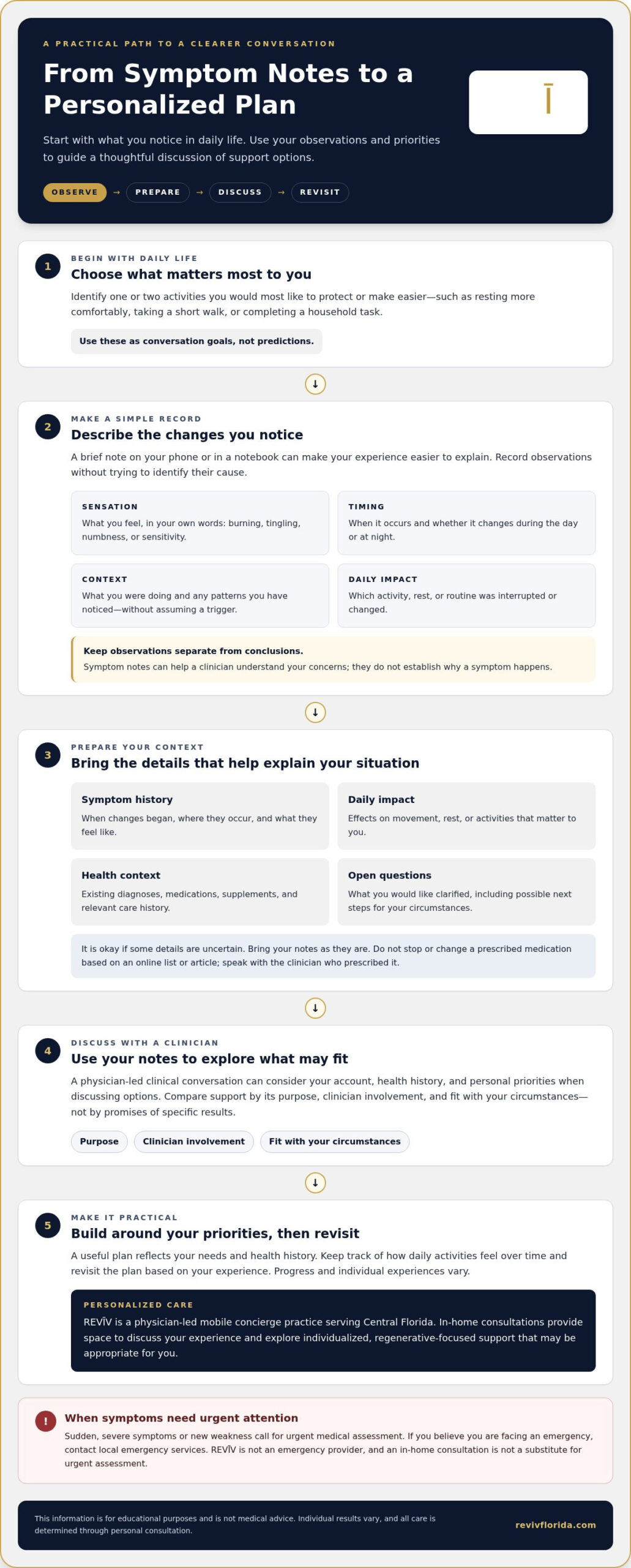
Build a Practical Plan Around the Activities You Want Back
A useful plan starts with your life, not a generic list of goals. Think about one routine you value, perhaps preparing a meal, getting ready for the day, or spending time outdoors. The aim isn’t to take on everything at once or set a target that assumes a particular result. It’s to clarify what matters and give your clinician a practical place to begin.
Try this simple sequence:
- Choose an activity: Pick one routine that feels meaningful to you.
- Notice the barriers: Record what makes it difficult, such as discomfort, altered sensation, fatigue, or concern about moving. Include only what you actually experience.
- Prepare to discuss it: Note what kind of support you hope to explore and what questions you’d like your clinician to address.
This keeps the conversation grounded in your priorities. A clinician can consider them alongside your health history and current care. Don’t start, stop, or change exercises, supplements, or other care based on a general article; discuss what may be appropriate for you with a clinician.
Choose a meaningful first step
Keep the first step manageable. If an everyday task feels challenging, describe which part is difficult and what would make the conversation more useful, rather than trying to redesign your whole routine. Your priorities may differ from someone else’s and can shift over time. That’s a reasonable part of an individualized plan.
Track experience without turning it into a promise
A simple journal can help you remember useful details between conversations. Note changes in sensations, activities you attempted, what felt difficult, and questions for your care team. Keep it brief enough to use comfortably. These notes can help organize your experience, but they can’t predict how you’ll respond to any option or guarantee a particular outcome.
Review the plan periodically with your clinician. Discuss whether your priorities have changed, which routines still feel challenging, and whether any guidance needs to be revisited. Adaptations should reflect your personal experience and clinical guidance, not pressure to meet a fixed improvement target.
For context on what this care approach can involve, the in-home regenerative medicine approach offers further background. A personalized discussion can help you consider whether supportive care fits your circumstances; potential benefits and experiences vary. If you’d like to discuss your priorities with the physician-led team, request a private consultation.
Explore Personalized Neuropathy Support at Home in Central Florida
Choosing a next step can begin with a conversation, not a commitment to a particular outcome. If you’re considering getting my life back from neuropathy pain, it may help to discuss what daily life looks like now, which activities matter most, and what kinds of support you’re interested in exploring. The right questions are personal, and so is the path forward.
REVĪV is a physician-led mobile concierge practice serving Central Florida, including Orlando, Winter Park, Maitland, Altamonte Springs, Longwood, Casselberry, Orange City, DeLand, Deltona, Apopka, Oviedo, Winter Springs, Lake Mary, Sanford, Kissimmee, Winter Haven, Davenport, Titusville, Melbourne, and Melbourne Beach. Care comes to you, creating an in-home setting for a thoughtful discussion of symptoms, priorities, and possible regenerative-focused options. These options are designed to support the body’s natural repair and recovery processes. Whether an approach may be suitable, and what potential benefits may apply, can be discussed through personal consultation.
What to expect from a personalized conversation
A consultation with Dr. Cheesman, DO, and the physician-led clinical team can include a review of your health history, current concerns, daily function, and personal goals. Bring notes about symptoms, current care, and questions you’d like answered. This helps keep the discussion connected to your circumstances rather than a general description of neuropathy.
The team uses the consultation to determine what care may be appropriate for you. No single approach is right for everyone, and an option that suits one person may not fit another. You can discuss what an approach is intended to support, its limits, and how it relates to your priorities. Your questions are part of the conversation.
Take the next step at your own pace
You don’t need to have every detail figured out before asking questions. It can be enough to explain what has changed, what you hope to protect in your routine, and what you’d like to understand about personalized support. A consultation is an opportunity to explore whether regenerative-focused care may fit your individual circumstances, without assuming a particular result.
If an in-home conversation feels like a useful next step, you can request a private consultation with REVĪV. Dr. Cheesman, DO, leads the clinical care, and any plan is determined through personal consultation. Individual experiences and results vary. Take the time you need to consider your questions and priorities.
This information is for educational purposes and is not medical advice. Individual results vary, and all care is determined through personal consultation.
Take One Thoughtful Step Toward What Matters
Getting my life back from neuropathy pain can begin with a clearer sense of what you want your days to include. You don’t have to map out every decision now. Consider what you’d like a clinician to understand about your experience and which questions would help you feel more informed about possible next steps.
A careful conversation can make room for your priorities, uncertainties, and individual circumstances without asking you to expect a particular result. The aim is to make your next decision with greater clarity, at a pace that feels right for you.
If you’re ready to explore a personalized discussion, request a private consultation. It’s a considered first step, not a promise of an outcome. Your experience is personal, and there’s value in approaching it with honest questions and realistic expectations.
You can move forward one informed step at a time.
Frequently Asked Questions
Can I get my life back while living with neuropathy pain?
Yes, getting my life back from neuropathy pain can mean finding ways to stay connected to activities that matter, even if symptoms remain part of your experience. The goal doesn’t have to be a perfect day. You might focus on maintaining a valued routine, adapting a task, or getting clearer guidance about your options. A clinician can help you consider priorities and support in light of your health circumstances.
Is neuropathy pain always permanent?
No single answer applies to everyone. Neuropathy describes a range of nerve-related concerns, and the course can depend on factors specific to the person and the underlying reason, if known. An online article can’t predict whether an individual’s symptoms will continue or change. A clinician can review your history, consider what evaluations may be appropriate, and discuss realistic expectations based on your situation.
What should I write down before discussing neuropathy symptoms with a clinician?
Note when you first noticed symptoms, where you feel them, how they have changed, and whether they interfere with a particular task or time of day. Add relevant health conditions, medications, supplements, and prior care. You may also want to write down what concerns you most and what you hope to understand. These details can help you use your consultation time well.
Can lifestyle changes support daily life with neuropathy?
Some adjustments may make everyday routines feel more manageable, but what’s suitable depends on your health and symptoms. You could ask a clinician whether changes to your home setup, rest routine, or the way you approach a demanding task make sense for you. For example, reducing clutter along a frequently used walkway may support safer movement at home. Discuss significant activity changes with a clinician first.
Do regenerative-focused options guarantee relief from neuropathy pain?
No. Regenerative-focused options don’t guarantee relief, and an individual’s experience can vary. REVĪV describes its care as designed to support the body’s natural repair and recovery processes. Whether this approach may be suitable, and what potential benefits may apply, are matters for an individual consultation with the physician-led clinical team. Be cautious of claims that promise a specific outcome without considering your circumstances.
Can I explore neuropathy support without traveling to a clinic?
Yes. REVĪV is a mobile concierge practice, so care comes to you through an in-home consultation. The practice serves Orlando and Central Florida communities including Winter Park, Maitland, Altamonte Springs, Longwood, Casselberry, Orange City, DeLand, Deltona, Apopka, Oviedo, Winter Springs, Lake Mary, Sanford, Kissimmee, Winter Haven, Davenport, Titusville, Melbourne, and Melbourne Beach.
Should I stop my current medication before exploring other support options?
No. Don’t stop or change a prescribed medication on your own to explore another option. Contact the clinician who prescribed it to discuss questions or possible changes. For a consultation about supportive care, bring an up-to-date list of prescriptions, over-the-counter products, and supplements so the clinical team can understand your current care and discuss your circumstances.
Disclaimer
For educational purposes only; not medical advice. Regenerative approaches
referenced are not FDA-approved to diagnose, treat, cure, or prevent any disease.
Individual results vary. Care is determined through individual consultation.
