
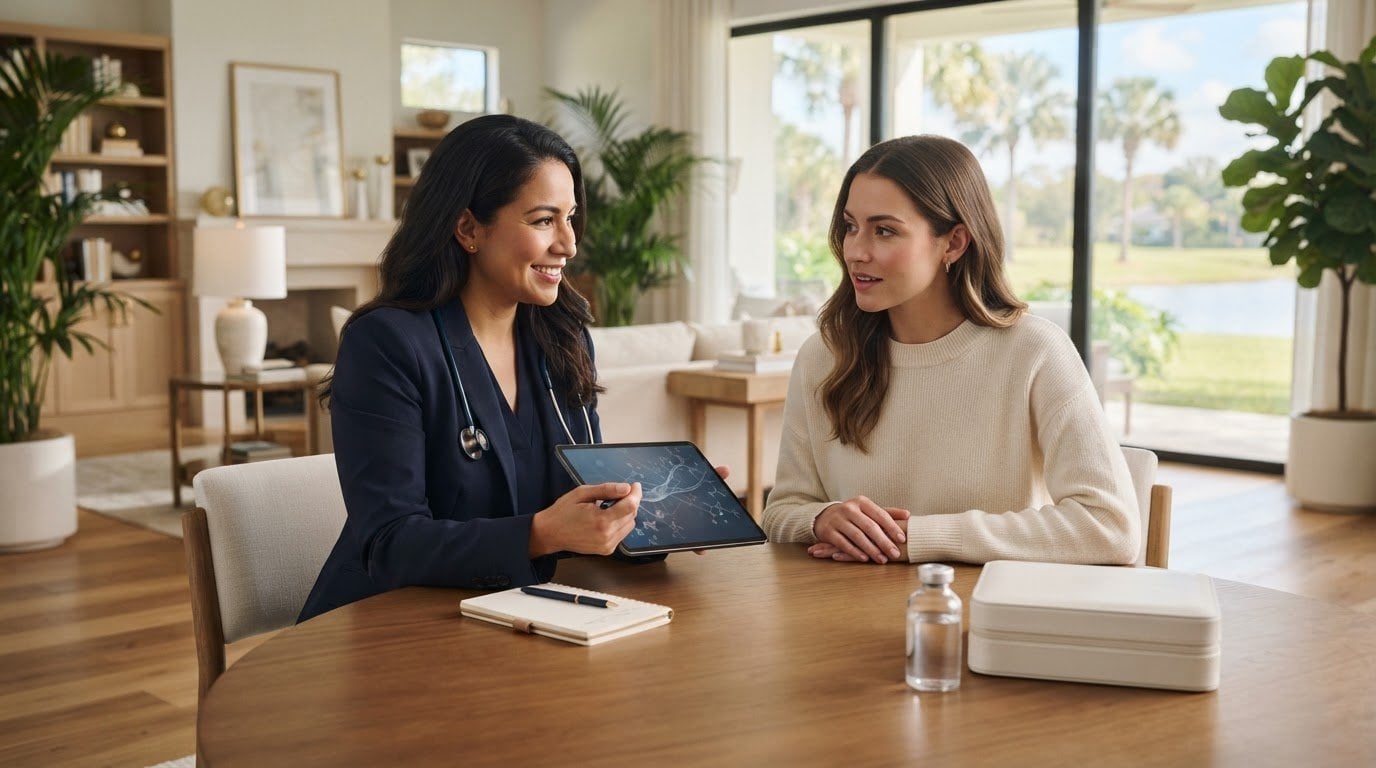
At-Home NAD+ for Cognitive Function in Davenport
Could at-home NAD+ for cognitive function Davenport fit your wellness goals? NAD+ plays a role in the body’s cellular processes, but that biological connection does not establish that supplementation improves memory, focus, or other aspects of cognition. Keeping that distinction in mind can help when online claims sound certain.
If you’re interested but cautious, that’s understandable. It helps to know what NAD+ does in the body, what research can and can’t say about cognitive wellness, and what an individualized at-home protocol may involve. Individual experiences vary, and any wellness approach should be considered in light of your health and goals.
This article explains the connection between NAD+ and cellular energy, outlines the limits of current evidence on cognitive outcomes, and describes how REVĪV’s physician-led mobile concierge practice approaches NAD+ protocols through individualized consultation in Davenport. The goal is informed discussion, not a promise of sharper thinking or a particular result.
This information is for educational purposes and is not medical advice. Individual results vary, and all care is determined through personal consultation.
Key Takeaways
- Learn what NAD+ does in cellular processes, and why that role alone does not establish a cognitive benefit.
- Separate a biological rationale from human research findings when considering claims about focus or memory.
- Consider personal goals, health context, and realistic expectations when deciding whether at-home NAD+ for cognitive function Davenport is worth discussing.
- Learn how a private consultation with REVĪV’s physician-led team can help shape individualized next steps, with mobile concierge care brought to you in Davenport.
- Keep wellness support in perspective: experiences vary, and NAD+ does not guarantee a cognitive outcome or replace medical advice.
Understanding At-Home NAD+ for Cognition in Davenport
Curiosity about focus, memory, or occasional brain fog is understandable. These experiences can have many possible explanations, and noticing them does not by itself point to a diagnosis. It’s also reasonable to ask whether NAD+ belongs in a conversation about cognitive wellness, particularly when online claims make the science sound more settled than it is.
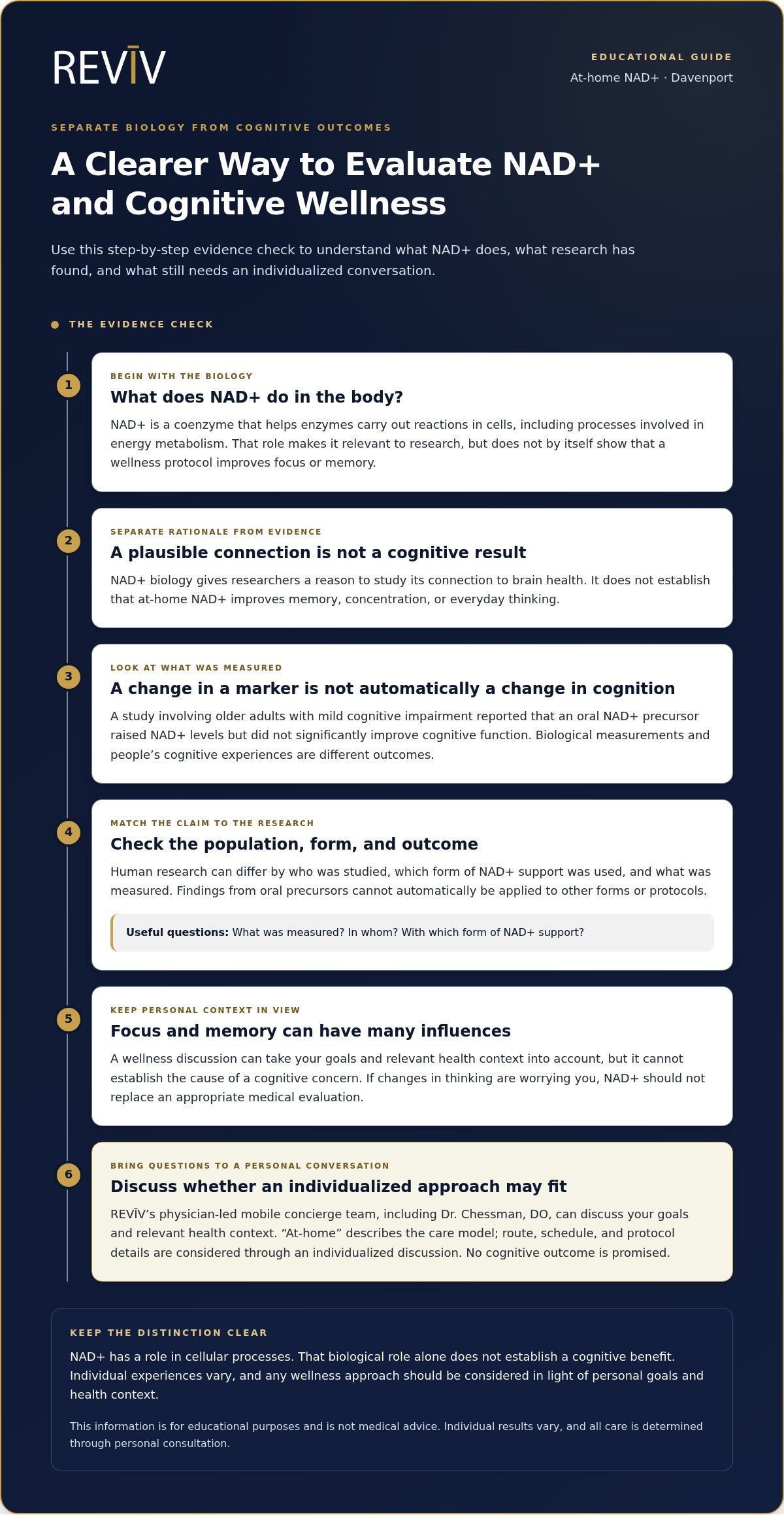
NAD+ (nicotinamide adenine dinucleotide) is a molecule found in the body that helps cells carry out essential processes, including those involved in energy metabolism. This cellular role makes NAD+ scientifically relevant, but it does not show that an NAD+ wellness protocol improves focus or memory. Those are separate questions and should be considered separately.
What is NAD+, in plain language?
Nicotinamide adenine dinucleotide (NAD+) is a coenzyme, a molecule that helps enzymes carry out reactions in cells. Think of it as a reusable partner in some of the processes cells use to manage energy. The analogy is limited, but it helps distinguish NAD+’s natural role in the body from a supplement or clinical protocol. The molecule itself is not the same as a wellness product or an individualized care plan.
What does “at-home NAD+” mean in Davenport?
At REVĪV, NAD+ protocols are part of targeted supplementation and wellness support focused on cellular health. REVĪV is a physician-led mobile concierge practice that brings care to patients in Davenport. “At-home” describes this care model, not a specific route, schedule, or protocol. Those details are considered through an individualized discussion.
A private consultation with the clinical team, including Dr. Cheesman, DO, gives you a chance to share your goals and relevant health context and discuss whether a personalized wellness approach may be appropriate. The conversation is not a promise of cognitive improvement. Individual experiences vary, and the relationship between NAD+ biology and an individual’s focus or memory remains a separate consideration.
This article explains concepts and questions to consider, not an individual medical recommendation. Keep the distinction in mind as you read: biological relevance can explain why NAD+ is being discussed, but it cannot establish a cognitive outcome. This information is for educational purposes and is not medical advice. Individual results vary, and all care is determined through personal consultation.
What science says, and does not yet establish, about NAD+ and cognition
NAD+ has a role in cellular processes, giving researchers a reason to study its connection to brain health. But a plausible mechanism is not evidence that a wellness protocol leads to meaningful changes in memory, focus, or everyday thinking. The relevant question is not only whether NAD+ levels change, but whether people experience a measurable difference in cognition.
How to read claims about NAD+ and brain health
Human research provides context, but findings depend on the population studied, the form of NAD+ support, and the outcomes measured. A 2026 study involving older adults with mild cognitive impairment reported that an oral NAD+ precursor raised NAD+ levels but did not significantly improve cognitive function. A change in a biological marker does not automatically translate into a change in how someone thinks or feels.
Evidence summary: Research supports a biological rationale for studying NAD+, but current findings do not establish that at-home NAD+ improves cognition. Results from oral precursors also cannot automatically be applied to other forms or protocols. The evidence remains preliminary, and individual experiences may differ.
That distinction matters when assessing phrases such as “supports brain health” or “helps with brain fog.” Ask what was measured, in whom, and with which form of NAD+ support. A claim about cellular activity is not, by itself, evidence of improved concentration, clearer thinking, or better memory. The research should match the specific claim being made.
Why individual context matters
Focus and memory can be affected by many personal and health-related factors. A wellness discussion can take your goals and relevant health context into account, but it cannot establish the cause of a cognitive concern. If changes in thinking are worrying you, NAD+ should not replace an appropriate medical evaluation.
If you’re considering at-home NAD+ for cognitive function Davenport, a private consultation with REVĪV’s physician-led team can help you discuss whether a personalized wellness approach may fit your circumstances. The conversation can help set realistic expectations and consider individual suitability without promising a cognitive outcome.
To learn more about personalized NAD+ wellness care, explore REVĪV’s approach to cellular wellness. Individual results vary, and all care is determined through personal consultation.
How to evaluate an at-home NAD+ option without relying on broad promises
A useful evaluation separates three things: what NAD+ does in cells, what a study actually found, and what a person might experience. These are related, but they are not interchangeable. A claim about cellular activity does not establish a cognitive outcome, and a finding in one group or with one approach may not apply to everyone.
What makes a cognitive-wellness claim credible?
Look for clear language about the evidence and its limits. Does the claim describe a proposed mechanism, a change measured in a study, or a meaningful difference in cognition? Does the human research involve a relevant population and measure the outcome being discussed? Promotional certainty without those details deserves careful consideration.
| Consideration | What to look for | Why it matters |
|---|---|---|
| Biological rationale | An explanation of NAD+’s cellular role | A mechanism can explain interest in a topic, but it does not establish a cognitive benefit. |
| Evidence | Human research relevant to the stated outcome and population | Changes in a biological marker are not automatically changes in focus or memory. |
| Individual fit | Consideration of personal goals and health context | Research findings do not determine whether an approach is suitable for a particular person. |
What should a personalized discussion consider?
A wellness goal might be to learn about cellular health and explore options with realistic expectations. Expecting a protocol to address a diagnosed condition or a concerning change in cognition is different. NAD+ wellness support should not be presented as a substitute for medical advice or an evaluation of cognitive concerns.
In a physician-led consultation, REVĪV’s clinical team, including Dr. Cheesman, DO, can discuss questions such as:
- What are your wellness goals, and what do you hope to understand or support?
- What health context or other considerations are relevant to the conversation?
- What does current evidence say, and what remains uncertain about the outcome you’re interested in?
- What next steps, if any, are appropriate for your individual circumstances?
There isn’t one NAD+ approach that fits everyone. For at-home NAD+ for cognitive function Davenport, a personal discussion can bring goals, evidence, and expectations into the same conversation without promising a result. Read more about longevity medicine and in-home care to understand REVĪV’s concierge wellness perspective.
What to expect when exploring mobile NAD+ wellness care in Davenport
Exploring a wellness option can begin with a conversation, not a commitment to a particular protocol. For Davenport residents, REVĪV’s physician-led mobile concierge practice brings care to the patient. The process focuses on your goals and health context, with next steps determined through personal consultation rather than assumed in advance.
How a private consultation supports individualized decisions
A private consultation with the clinical team, including Dr. Cheesman, DO, gives you space to explain what you hope to support, ask questions about NAD+ wellness, and share relevant health context. You can also discuss what the available evidence can and cannot tell you, helping keep expectations grounded.
The discussion can then consider whether a personalized NAD+ approach may be appropriate and what next steps make sense for you. No single option suits everyone, and potential benefits and experiences vary. A conversation about cognitive wellness is not a promise of improved focus or memory, nor does it replace medical advice about cognitive concerns.
Why care at home may suit some Davenport residents
Mobile concierge care offers a different setting: the clinical team comes to the patient rather than asking the patient to travel to a clinic. For some Davenport residents, that in-home model may feel more convenient or comfortable. It describes how care is delivered, not a clinical benefit or a specific NAD+ route, schedule, or protocol.
A helpful way to think about the process is:
- Share your goals. Describe the wellness questions or priorities you’d like to discuss.
- Discuss your context. Share relevant health information and concerns with the clinical team.
- Consider options. Review what may be suitable for your individual circumstances and what remains uncertain.
- Determine next steps. Any care decision is made through personal consultation, without assuming a particular outcome.
For a broader look at REVĪV’s concierge wellness approach, explore the practice overview. If you’re considering at-home NAD+ for cognitive function Davenport, a private discussion can help you weigh personal goals alongside realistic expectations. Individual results vary, and all care is determined through personal consultation.
Learn more about REVĪV’s care through a private consultation with the physician-led team.
Next Steps for At-Home NAD+ Wellness in Davenport
A thoughtful next step brings together what research says, your personal health context, and what you realistically hope to gain. NAD+ has a role in cellular processes, but that biological role does not establish that a wellness protocol will improve memory, focus, or other aspects of cognition. It’s best approached as an individualized wellness discussion, not a promised result.
For Davenport residents exploring at-home NAD+ for cognitive function Davenport, a consultation can help clarify personal goals and discuss whether NAD+ wellness support may be appropriate in light of individual circumstances. It can also help set expectations: experiences vary, and no cognitive outcome is guaranteed. NAD+ wellness support is not a substitute for medical advice or evaluation of cognitive concerns.
Who may want to explore a consultation?
Adults curious about cellular wellness may value a personalized conversation with a physician-led clinical team. Interest alone does not establish that a particular approach is suitable, and a concern about focus or memory does not determine eligibility. The discussion is an opportunity to share what matters to you, hear what is and isn’t known, and consider next steps without pressure.
If changes in memory, focus, or thinking are concerning or continuing, seek an appropriate professional evaluation. A wellness conversation should not take the place of care for a cognitive concern. Exploring general wellness is different from determining why a change is happening.
How to take the next step without pressure
You don’t need to arrive with a decision already made. To make a private consultation more useful, consider bringing:
- Your goals: What aspect of cellular wellness are you curious about?
- Your questions: What evidence, uncertainties, or expectations would you like to discuss?
- Relevant context: What health information may help the clinical team understand your circumstances?
REVĪV is a physician-led mobile concierge practice serving Davenport, with care brought to the patient. Dr. Cheesman, DO, and the clinical team can discuss your goals and context as part of an individualized conversation. Any care decisions are made through personal consultation, and individual experiences vary.
Individual results vary, and all care is determined through personal consultation.
Explore whether a personalized NAD+ wellness discussion fits your goals by visiting REVĪV’s consultation page. There’s no need to arrive with a predetermined plan.
Explore NAD+ Wellness With Clear Expectations
NAD+ is involved in cellular processes, but that role alone does not establish a cognitive benefit. Research findings and personal experiences can vary, so consider the evidence, your health context, and your expectations together. At-home NAD+ for cognitive function Davenport is best approached as a personalized wellness discussion, not a promise of sharper focus or memory.
REVĪV’s physician-led clinical team, including Dr. Cheesman, DO, offers mobile concierge care in Davenport and Central Florida. A private consultation can consider your goals and health context and discuss personalized NAD+ protocols and targeted supplementation for cellular wellness. If you have concerning or changing cognitive symptoms, wellness support is not a substitute for medical advice or an appropriate evaluation.
Individual results vary, and all care is determined through personal consultation. To discuss your goals without pressure, request a private consultation. A thoughtful next step can begin with a conversation.
Frequently Asked Questions
Can NAD+ improve cognitive function?
Current evidence does not establish that NAD+ wellness protocols improve cognitive function. NAD+ is involved in cellular processes, which provides a reason for scientific interest, but a biological role is not proof of a change in memory, focus, or daily thinking. Human findings depend on the population, the form of support studied, and the outcome measured. Individual experiences vary, so cognitive benefits should not be assumed.
Does NAD+ cross the blood-brain barrier?
It isn’t appropriate to assume that NAD+ given as a wellness protocol reaches the brain directly. The blood-brain barrier regulates movement of substances from the bloodstream into the brain, and delivery can depend on the specific molecule and method studied. Research on NAD+ precursors or changes in NAD+ levels does not automatically show that NAD+ itself crosses this barrier or improves cognition. That distinction matters when interpreting brain-health claims.
Is at-home NAD+ appropriate for everyone?
No single wellness approach is right for everyone. Whether a personalized NAD+ protocol may be appropriate depends on an individual’s goals and health context, and that can only be discussed through personal consultation. Interest in cellular wellness, brain fog, or memory support does not by itself establish suitability. Share relevant health information with the physician-led clinical team so the conversation can consider your circumstances without assuming an outcome.
What happens during an at-home NAD+ consultation in Davenport?
A private consultation is a chance to share your goals, discuss relevant health context, ask questions, and consider possible next steps with REVĪV’s physician-led clinical team, including Dr. Cheesman, DO. REVĪV is a mobile concierge practice serving Davenport and Central Florida, with care brought to the patient. Its service area includes Orlando, Winter Park, Maitland, Altamonte Springs, Longwood, Casselberry, Orange City, DeLand, Deltona, Apopka, Oviedo, Winter Springs, Lake Mary, Sanford, Kissimmee, Winter Haven, Davenport, Titusville, Melbourne, and Melbourne Beach.
Can NAD+ help with brain fog or memory concerns?
There isn’t enough evidence to say that NAD+ wellness support will help with brain fog or memory concerns. These experiences can have different explanations, and a wellness protocol should not be treated as a way to determine their cause. If changes in memory, focus, or thinking are concerning or ongoing, seek an appropriate medical evaluation. A separate wellness consultation can discuss cellular health goals and realistic expectations.
How is a personalized NAD+ protocol decided?
A clinician considers the person, not just the goal. In a private consultation, the team can discuss your wellness priorities, relevant health context, questions, and expectations before considering whether NAD+ support may be suitable. REVĪV’s NAD+ protocols are part of its targeted supplementation and cellular wellness offering. No route, schedule, or outcome should be assumed in advance; care decisions are individualized, and experiences vary.
Is NAD+ a substitute for medical advice about cognitive changes?
No. NAD+ wellness support is not a substitute for medical advice or an evaluation of changes in memory, focus, or thinking. If symptoms are concerning or changing, speak with a qualified medical professional about appropriate evaluation. A physician-led wellness consultation can address separate questions about cellular health and personal goals, but it cannot promise a cognitive outcome. All care decisions are made through personal consultation, and individual results vary.
Disclaimer
For educational purposes only; not medical advice. Regenerative approaches
referenced are not FDA-approved to diagnose, treat, cure, or prevent any disease.
Individual results vary. Care is determined through individual consultation.
