

Exosome Treatment for Inflammation: A Science-Backed Guide
Exosomes are best understood as biological messengers, not a quick fix. If chronic joint or spine discomfort is limiting your mobility, it’s understandable to explore options beyond surgery or medications that haven’t suited you. The phrase “exosome treatment for inflammation” refers to an area of ongoing research into how tiny particles released by cells carry signals between cells. That research is developing, and scientific interest is not the same as an established clinical option.
This guide explains what exosomes are, what researchers are exploring about their role in cellular signaling, and what to consider when evaluating claims about inflammation and mobility. It also covers how a physician-led, individualized consultation can help clarify non-surgical, regenerative-focused options designed to support the body’s natural repair and recovery processes. REVĪV’s clinical team provides mobile concierge care in Central Florida, bringing personalized guidance into the comfort of your home. Individual experiences vary, and care decisions are made through personal consultation.
Key Takeaways
- Exosomes are tiny biological messengers that help cells communicate. Researchers are studying their possible role in inflammatory signaling.
- Understand what current research can and can’t tell us about exosome treatment for inflammation, without confusing emerging science with established care.
- A physician can consider joint or spine concerns alongside your health history, symptoms, and mobility goals.
- Regenerative-focused options should be personalized. Potential benefits and individual experiences vary.
- REVĪV’s mobile concierge model brings physician-led, individualized care into the comfort of home.
What are Exosomes? Understanding the Body’s Signaling System
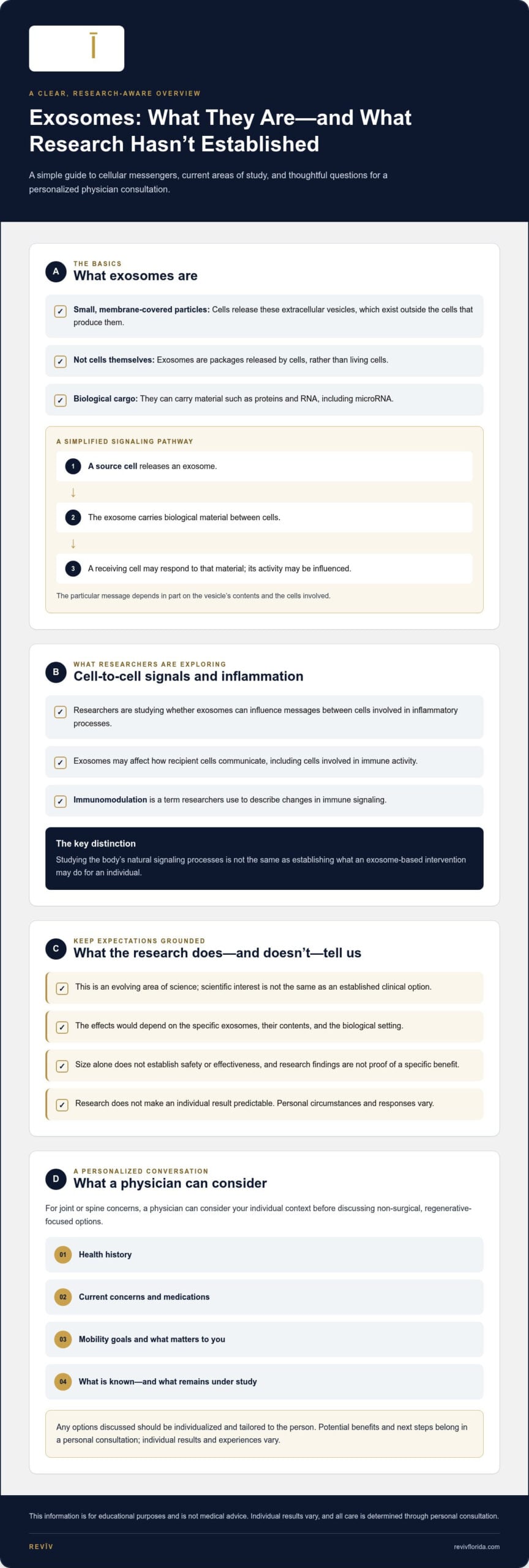
Cells don’t work in isolation. They send and receive signals that help coordinate activity throughout the body. Exosomes are small, membrane-covered particles released by cells. They’re extracellular vesicles, which means they exist outside the cells that produce them. They aren’t cells themselves. One way to picture them is as tiny envelopes that can carry biological material, including proteins and RNA, to other cells.
This role in cell-to-cell communication is why researchers are studying exosomes in connection with inflammation and recovery. For a foundational overview of their origin and function, see Exosome (vesicle). This biology is an area of scientific interest, but it doesn’t establish that an exosome-based intervention will produce a particular result for an individual.
The Mechanism of Intercellular Communication
Exosomes can carry molecular “instructions” from a source cell to another cell. Their cargo may include proteins and microRNA, a type of RNA involved in regulating how cells use genetic instructions. When a receiving cell takes up or responds to this cargo, its activity may be influenced. The particular message depends in part on the vesicle’s contents and the cells involved.
In simple terms, exosomes are tiny extracellular vesicles involved in signaling between cells. That’s a simplified explanation of a complex process, not a promise that a particular signal will lead to a predictable change in the body.
Exosomes vs. Traditional Biologics
“Biologics” is a broad term for products derived from biological sources, and it includes different materials and approaches. Exosomes are distinct from whole cells: they’re packages released by cells rather than living cells themselves. Their size and cargo make them a subject of research into how biological messages move between cells. Size alone, however, doesn’t establish safety or effectiveness, and research findings aren’t proof of a specific benefit.
The phrase exosome treatment for inflammation often appears in discussions of this emerging field. It’s useful to distinguish the body’s natural signaling processes from claims about using exosomes as an intervention. Cellular health and longevity research may also examine how cell communication relates to normal function over time, but individual outcomes can’t be assumed from that research. Any discussion of regenerative-focused options should be grounded in a personalized medical consultation and a clear understanding of what is known and what remains under study.
The Biological Mechanism: How Exosomes May Support Inflammatory Recovery
Inflammation is part of the body’s response to stress or injury. It changes over time as the body moves through different stages of response and recovery. In some joint concerns, inflammatory signaling may persist alongside discomfort or limited movement. Researchers are studying whether exosomes can influence messages between cells involved in these processes. This is an evolving area of science, not evidence that an exosome-based approach will produce a specific outcome.
Targeting the Inflammatory Cascade
A signaling cascade is a chain of messages that can prompt cells to respond. Exosomes carry biological material that may affect how recipient cells communicate, including cells involved in immune activity. Researchers use the term immunomodulation to describe changes in immune signaling. In theory, influencing these signals could support a more balanced cellular environment. The effects would depend on the specific exosomes, their contents, and the biological setting.
Research also shows why broad claims deserve careful consideration. A National Institutes of Health overview of exosomes in chronic inflammation describes a study involving dysfunctional exosomes in chronic inflammation related to diabetic wounds. It illustrates that exosome activity can be complex; it doesn’t establish exosomes as a general solution for joint or spine concerns.
Supporting Cellular Vitality
Exosome-focused approaches are discussed as a way to support natural tissue signaling, rather than as a replacement for the body’s own restorative pathways. The research explores whether cell-to-cell messages might influence how cells coordinate their responses. Whether that translates into meaningful changes in comfort or function remains an individual medical question, not a predictable result.
In a personalized consultation, a physician can consider your health history, current concerns, medications, and mobility goals before discussing non-surgical, regenerative-focused options. Individual results and experiences vary. The phrase exosome treatment for inflammation should not be understood as an established outcome or a guaranteed shift from a “pro-inflammatory” to a “pro-recovery” state.
Cellular Health and NAD+ Protocols
Cellular communication is one part of a broader conversation about healthy function over time. NAD+ protocols are another area of focus in cellular health, but discussing them alongside exosomes doesn’t demonstrate that the approaches work synergistically. REVĪV offers targeted supplementation and NAD+ protocols as part of personalized wellness care. Any consideration of supplementation or regenerative-focused options should be individualized and guided by a physician, with clear expectations about what is known and what remains under study.
For guidance tailored to your health history and goals, you can request a personalized physician consultation with REVĪV’s clinical team.
Orthopedic Applications: Addressing Spine and Joint Inflammation
Discomfort in a knee, shoulder, hip, or spine can make everyday movement more difficult. In these areas, inflammation may be one part of a broader picture that also includes the joint or surrounding tissues, overall health, and activity level. Researchers are exploring how exosome signaling relates to inflammatory processes, but that research doesn’t establish exosome-based care as a proven option for orthopedic concerns or predict an individual result.
For people hoping to avoid surgery, a physician can discuss non-surgical, regenerative-focused options after reviewing their health history and goals. The phrase exosome treatment for inflammation describes an area of interest, not a guaranteed path to less discomfort or better mobility. A consultation can help clarify what is known, what remains uncertain, and which personalized options may be appropriate.
Managing Joint Discomfort Without Surgery
Knee discomfort may affect walking or using stairs, while shoulder concerns, including those involving the rotator cuff, can make reaching difficult. Hip or spinal discomfort can also limit daily movement. Exosome research looks at whether cell-to-cell signals may influence the local cellular environment; it doesn’t show that an exosome protocol will restore function for every person. Learn more about non-surgical options for knee pain as part of a broader discussion of individualized care.
Regenerative-focused care is designed to support the body’s natural repair and recovery processes, with mobility goals considered during personal consultation. Some people explore options beyond relying solely on pharmaceutical pain management by discussing non-surgical approaches with a physician. These approaches aren’t interchangeable, and medication decisions should be made with a qualified clinician.
Spine Concerns and Nerve Health
Spine-related discomfort can involve multiple structures, and symptoms may have different causes. Research interest in exosomes doesn’t make them an established answer for back pain. A physician-led assessment can help put symptoms, medical history, and functional goals into context. REVĪV’s page on regenerative medicine for spine pain offers additional information about non-surgical, regenerative-focused care.
Numbness, tingling, or altered sensation also call for individualized evaluation. Exosomes are being studied in relation to cell signaling, including pathways relevant to nerve health, but potential effects depend on many personal health factors and remain uncertain. Central Florida patients can learn about REVĪV’s approach to neuropathy and nerve health. Individual experiences vary, and care decisions are made through personal consultation.
Evaluating Regenerative Options: What to Expect from Personalized Protocols
Regenerative medicine isn’t one-size-fits-all. Similar symptoms can have different causes, and a person’s health history, daily activities, and goals all matter when considering care. Exosome research is still developing, so discussion of exosome treatment for inflammation should distinguish scientific interest from established clinical options. A personal consultation helps put the research and available non-surgical, regenerative-focused approaches in the context of your individual needs.
The process is collaborative. You can share what’s limiting you and what you hope to do more comfortably; the clinical team reviews your concerns and discusses appropriate next steps. No particular benefit can be assumed, and individual experiences vary.
The Importance of an Individualized Plan
An “off-the-shelf” approach may miss important differences between people, such as the source of discomfort, other health factors, or the movements they want to regain. A thoughtful plan begins with a detailed medical history and physical assessment, followed by a conversation about priorities, possible options, and realistic expectations.
Dr. Cheesman, DO, and the physician-led clinical team tailor discussions of regenerative care to each person’s orthopedic goals, whether those involve the knee, shoulder, hip, or spine. Targeted supplementation, including cellular health and NAD+ protocols, may also be considered as part of an individualized wellness plan. Supplementation isn’t a substitute for evaluation, and its role should be discussed in light of personal health factors.
Safety, Quality, and Clinical Oversight
Before considering an emerging approach, it’s reasonable to understand what is being proposed, what is known about it, and what uncertainties remain. For exosome-focused approaches in particular, research is evolving. Scientific interest doesn’t establish a specific benefit or make an approach appropriate for every person. Sourcing and product quality are important considerations, and a physician-led discussion should address them without promising an outcome.
Clinical oversight also means weighing potential risks and alternatives, reviewing relevant health information, and considering how progress would be assessed. REVĪV’s mobile concierge model brings physician-led care to patients in Central Florida, which can be helpful for those who find travel challenging. Any plan is determined through personal consultation.
Non-surgical options vary, and “non-surgical” doesn’t automatically mean risk-free or minimally invasive. The details depend on the approach being discussed and a person’s circumstances. If you’d like to talk through your goals and individualized options with the clinical team, request a private consultation.
Physician-Led Mobile Care: The REVĪV Approach to In-Home Restoration
Care can come to you. REVĪV is a physician-led mobile concierge practice serving Central Florida, including Orlando and Melbourne. For people whose mobility makes travel difficult, an in-home visit offers a convenient setting to discuss health concerns and goals. Learn more about mobile regenerative medicine in Orlando.
Exosome research is still developing. This educational discussion is not a promise of a particular result. A consultation with Dr. Cheesman, DO, can help you understand non-surgical, regenerative-focused options in light of your needs. Any care plan is individualized, and potential benefits and experiences vary.
The Concierge Experience in Central Florida
An in-home conversation can take place in a familiar, private setting, without the need to travel to a waiting room. That convenience may be especially meaningful if getting around is challenging. A home visit brings the consultation to you; it doesn’t itself change inflammation or replace clinical evaluation.
Rather than making assumptions about what someone needs, the clinical team can listen to your concerns, review relevant health history, and discuss how daily movement is affected. The goal is attentive, personalized guidance, not a rushed or one-size-fits-all conversation. A thoughtful discussion at home can make it easier to explore next steps without the added logistics of a waiting room.
Taking the Next Step Toward Mobility
A private consultation begins with a conversation about what you’re experiencing, your health background, and the activities you hope to pursue more comfortably. During an in-home assessment, the physician-led team can review your concerns and discuss appropriate next steps. All care is determined through personal consultation, and no outcome can be assumed in advance.
For those exploring exosome treatment for inflammation, it’s important to distinguish ongoing research from established care. A physician can help place emerging science in context and discuss individualized options without making unsupported promises. REVĪV also focuses on wellness and longevity; learn more about longevity medicine in Orlando.
If you’d like to discuss your mobility goals and personal circumstances with the clinical team, request a private consultation. This information is for educational purposes and is not medical advice. Individual results vary, and all care is determined through personal consultation.
Take a Personalized Step Toward Greater Mobility
Exosomes are tiny biological messengers that researchers are studying for their role in cell communication and inflammatory signaling. That interest is not a guarantee of benefit: research on exosome treatment for inflammation is still developing, and individual outcomes can’t be assumed. Understanding what research suggests, and what remains uncertain, is an important starting point.
For joint or spine concerns, the next step is a conversation about your health history, mobility goals, and the options that may be appropriate for you. REVĪV’s physician-led clinical team, under Dr. Cheesman, DO, provides mobile concierge care in the comfort of your home. Personalized, non-surgical regenerative-focused options are considered through individual consultation, and each person’s experience varies.
You don’t have to decide on a particular approach before asking questions. A private discussion can help you understand available paths and make an informed choice at your own pace. Request a private consultation with Dr. Cheesman, DO to explore tailored guidance for your mobility and wellness goals.
Frequently Asked Questions
Can exosome-focused protocols help with my knee pain?
It isn’t possible to predict whether exosome-focused protocols will help your knee. Exosomes are being studied for their role in cellular signaling, but research interest doesn’t establish a specific benefit for knee discomfort. The phrase exosome treatment for inflammation describes an area of exploration, not a guaranteed outcome. A physician can review your health history, symptoms, and mobility goals in a personal consultation and discuss individualized, non-surgical regenerative-focused options.
How long does an in-home regenerative session take?
There isn’t one standard session length that applies to every person or type of care. The time involved may depend on the purpose of the visit and what’s discussed or planned after reviewing your individual needs. REVĪV’s mobile concierge model brings care to your home, which can make a visit more convenient if travel is difficult. Specific care and next steps are determined through personal consultation.
Are these exosome treatments designed for spine and back issues?
Exosomes are an area of research, but that doesn’t establish an exosome-based approach as a specific option for spine or back concerns. REVĪV provides in-home regenerative care for spine and joint pain, with options considered individually rather than assumed from a general description of exosomes. A consultation can take into account your symptoms, health history, and functional goals. Individual experiences vary, and care decisions are made through personal consultation.
What is the difference between exosomes and stem cells?
Exosomes are small vesicles released by cells that carry biological material involved in cell-to-cell communication. They aren’t cells themselves. Stem cells, by contrast, are living cells with the ability to develop into certain cell types under particular conditions. The terms aren’t interchangeable, and research involving one doesn’t automatically establish the effects of the other. A physician can explain these distinctions and discuss what is known about an approach you’re considering.
Is Dr. Cheesman, DO the one who performs the consultation?
REVĪV is a physician-led practice led by Dr. Cheesman, DO. Your care is determined through personal consultation, with your concerns and health history considered before an individualized plan is discussed. The clinical conversation can include your mobility goals and non-surgical, regenerative-focused options relevant to your needs. Individual experiences vary, so a consultation is an opportunity to discuss what may be appropriate for you without assuming a particular outcome.
Which areas of Florida does your mobile practice serve?
REVĪV serves Central Florida, including Orlando, Winter Park, Maitland, Altamonte Springs, Longwood, Casselberry, Orange City, DeLand, Deltona, Apopka, Oviedo, Winter Springs, Lake Mary, Sanford, Kissimmee, Winter Haven, Davenport, Titusville, Melbourne, and Melbourne Beach. As a mobile concierge practice, care comes to the patient’s home. This can be helpful for people who find travel challenging. Care is personalized and arranged through consultation with the physician-led team.
Is this considered a non-surgical alternative to joint replacement?
Regenerative-focused care is non-surgical, but it shouldn’t be described as a replacement for joint replacement or as a way to avoid surgery in every case. These are different approaches, and whether a non-surgical option may fit your circumstances requires an individualized medical consultation. A physician can discuss your health history, mobility goals, and available options. Individual results and experiences vary, and no particular outcome can be promised.
How many sessions are typically required for inflammatory support?
There isn’t a standard number of sessions that can be recommended for everyone, and no specific session count should be assumed for inflammatory support. The appropriate plan depends on the individual, the concerns being discussed, and the care determined after consultation. REVĪV’s physician-led team considers each person’s health history and goals when discussing next steps. Individual experiences vary, and all care is determined through personal consultation.
Disclaimer
For educational purposes only; not medical advice. Regenerative approaches
referenced are not FDA-approved to diagnose, treat, cure, or prevent any disease.
Individual results vary. Care is determined through individual consultation.
