
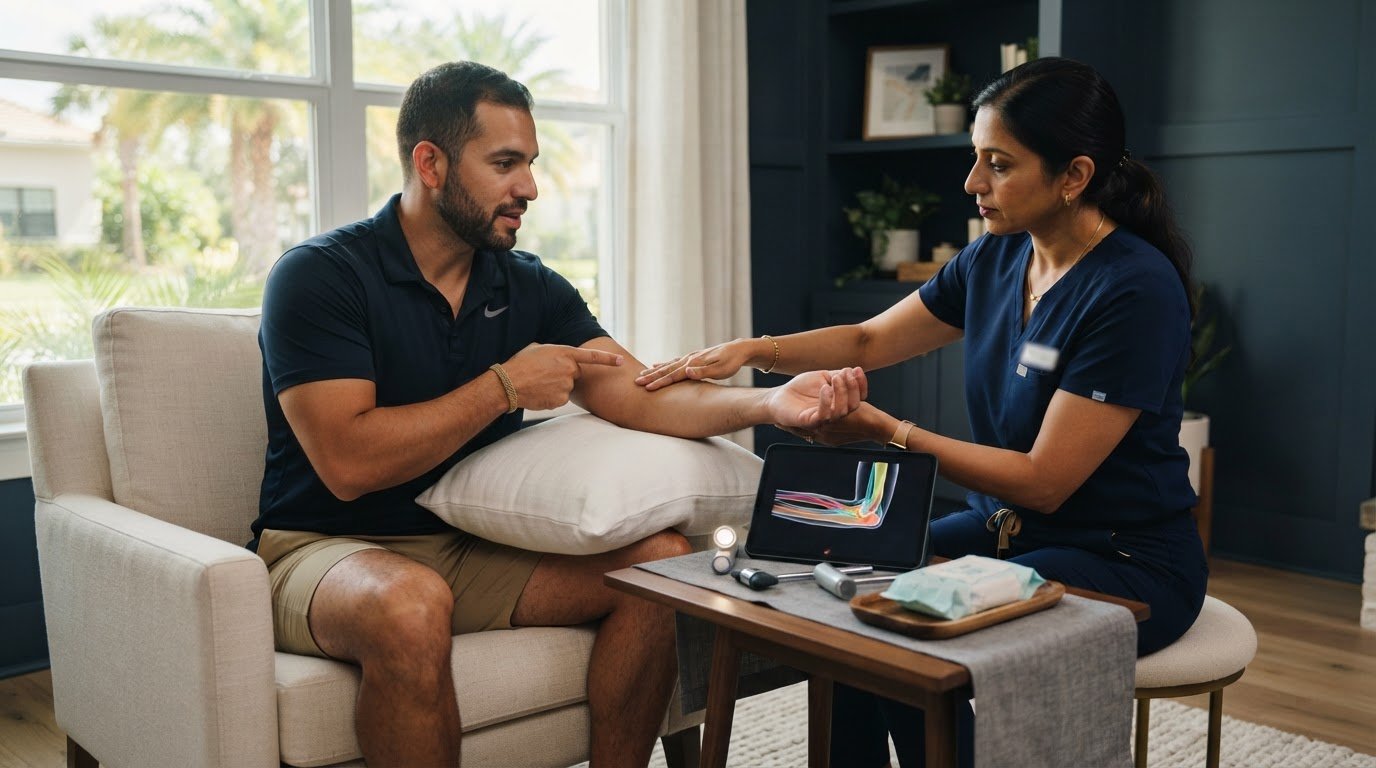
Regenerative Therapy for Tennis Elbow in Casselberry: What to Know
The most useful question isn’t whether regenerative care sounds promising. It’s whether a particular option fits your elbow and your needs. If gripping, working, or exercising brings discomfort, it’s understandable to look for a clear next step. The search for regenerative therapy for tennis elbow Casselberry should begin with an assessment, not a promise. Tennis elbow commonly involves discomfort around the outside of the elbow, but a clinician can help assess what may be contributing to your symptoms and whether further evaluation is needed.
This article explains what tennis elbow may involve, how to evaluate regenerative-focused options with realistic expectations, and what questions to bring to a physician. It also offers ways to look beyond marketing language and ask about the rationale, potential benefits, uncertainties, and alternatives for any option being discussed. REVĪV is a physician-led mobile concierge practice serving Casselberry, though the team should confirm whether your concern falls within its scope. An individualized consultation with Dr. Cheesman, DO, can help clarify possible next steps. Potential benefits depend on personal circumstances, and individual results vary.
Key Takeaways
- Discomfort around the outer elbow can have different contributing factors. Note which activities bring it on and discuss your symptoms with a clinician.
- Regenerative-focused care is a broad category, not one specific procedure or a guaranteed outcome. Ask what a proposed option involves and what is known or uncertain.
- Compare a clinician assessment, conservative approaches, and a regenerative-focused consultation by their purpose, practical considerations, and fit for your circumstances.
- For regenerative therapy for tennis elbow Casselberry, prepare questions about individualized recommendations, potential benefits, uncertainties, and alternatives.
- REVĪV is a physician-led mobile concierge practice serving Casselberry. Confirm whether the team considers tennis-elbow concerns and whether an in-home consultation is appropriate for you.
Tennis elbow in Casselberry: understand the discomfort before comparing options
Before considering regenerative therapy for tennis elbow Casselberry, it helps to understand what the term may mean and what it doesn’t tell you. “Tennis elbow” is a common name for discomfort around the outside of the elbow. It’s also known as lateral epicondylitis, referring to the area near the bony prominence on the outer elbow where tendons involved in wrist and finger movement attach. Despite its name, the discomfort isn’t limited to people who play tennis.
What does tennis elbow usually refer to?
Repeated gripping, lifting, or wrist movements may contribute to irritation or strain around the outer elbow. You might notice discomfort while carrying a bag, lifting a pan, using tools, or doing other tasks that involve repeated hand and wrist use. Symptoms vary: some people notice discomfort during activity, while others find that everyday tasks become harder to manage.
Tennis elbow is commonly associated with changes involving the tendon on the outside of the elbow, but elbow discomfort can have other causes. This overview of tennis elbow describes the condition and its relationship to the tendons in this area. A name or symptom pattern alone, however, can’t establish what’s causing an individual’s discomfort.
When should someone seek an assessment?
Consider arranging a clinical assessment if elbow discomfort persists, worsens, or interferes with work, lifting, gripping, exercise, or other daily activities. A clinician can ask when it began, which movements affect it, and whether there was a relevant injury or health history. They can then help determine what further evaluation or next steps may be appropriate.
Seek urgent medical evaluation after a serious injury or for concerning symptoms such as marked swelling, an obvious change in the elbow’s shape, new numbness or weakness, or symptoms that feel severe or rapidly worsening. A clinician can advise on the appropriate level of care for your situation.
This overview is educational, not a diagnosis; an individualized clinical assessment is needed to help determine the cause of elbow discomfort. That distinction matters when comparing options, including any discussion of regenerative-focused care. If you’re exploring regenerative therapy for tennis elbow Casselberry, first confirm that the clinician considers your concern and ask how an individualized assessment would guide the discussion. Potential benefits and suitability depend on personal consultation, and individual experiences vary.
How regenerative-focused options are considered for tennis elbow
“Regenerative-focused care” describes a broad area of medical options, not one specific procedure or a standard plan for every person. The phrase alone doesn’t explain what a proposed option involves, what evidence supports its use for a particular concern, or whether it fits an individual’s health needs. Ask for those details before deciding what to explore.
REVĪV describes its approach as designed to support the body’s natural repair and recovery processes. The practice offers in-home regenerative care for spine and joint pain, but its available information doesn’t confirm a tennis-elbow-specific service, modality, or outcome. Ask the clinical team whether it considers this concern and what an individualized review could include. Suitability and potential benefits can only be discussed through an individual clinical consultation that considers your symptoms, function, health context, and the uncertainties of the option; experiences vary.
What should a patient expect from an individualized review?
A clinician may ask when the discomfort began, which activities affect it, and how it influences daily function, including work or lifting. They may also discuss relevant health history and any previous evaluation or care. This context helps the clinician consider whether further assessment is needed and whether another care path may be more appropriate. It isn’t a predetermined protocol.
Before moving forward, ask what an option is intended to do, what it involves, and how the clinician would assess whether it’s suitable for you. A careful discussion should leave room for questions and should not promise a particular result.
What evidence and limitations should be discussed?
Ask the physician to distinguish established information from emerging or uncertain evidence, and to explain how the evidence relates to your circumstances. Evidence about one approach, or about a different condition, may not establish whether an option is suitable for you. The Mayo Clinic’s overview of tennis elbow care options offers general background, but it can’t replace personal clinical guidance.
- What is known, and what remains uncertain, about this option for my concern?
- What other care paths could be considered, and why?
- What practical considerations and possible limitations should I understand?
If you’re considering regenerative therapy for tennis elbow Casselberry, REVĪV is a physician-led mobile concierge practice serving Central Florida, including Casselberry. You can learn about REVĪV’s concierge care and confirm whether the team considers tennis-elbow concerns before arranging a consultation. Any discussion of potential benefits depends on your individual assessment.
Compare tennis-elbow care options with realistic expectations
There isn’t one care path that fits everyone with outer-elbow discomfort. A useful comparison starts with the purpose of each option, what it asks of you, and what remains uncertain. The right discussion depends on the diagnosis, your health history, your preferences, and guidance from a qualified clinician. The options below are general categories, not a ranking or a recommendation for your situation.
| Care option | Purpose and questions to ask | Practical considerations and uncertainty |
|---|---|---|
| Clinician assessment | Clarify what may be contributing to the discomfort and whether further evaluation is needed. Ask what information or examination will guide the next steps. | Share how symptoms affect work and daily activities, along with relevant health history. The assessment may lead to additional evaluation or discussion of different care paths. |
| Conservative approaches | A clinician may discuss non-procedural ways to manage activities or support function. Ask which approaches may fit your needs and how they would be tailored. | Practical steps can depend on your symptoms, responsibilities, and personal circumstances. Ask how progress will be reviewed and what to do if symptoms persist or change. |
| Regenerative-focused consultation | Explore whether a regenerative-focused option is suitable, what it involves, and what is known or uncertain about its use for your concern. | This is a discussion, not a promise of a particular option or outcome. Ask about potential risks, practical requirements, alternatives, and when referral to another clinician may be appropriate. |
Questions to ask before choosing a care approach
Bring a short list to your appointment. Ask what assessment is needed, what alternatives may be appropriate, and why a particular option is being discussed. Find out what evidence applies to your circumstances and what remains uncertain. You can also ask about potential risks, practical requirements, how progress would be reviewed, and whether or when a referral may be recommended.
How to recognize realistic, patient-centered claims
A careful explanation makes room for questions. It describes who an option may suit, what is known, and where uncertainty remains, without promising that everyone will have the same experience. Be cautious of guaranteed outcomes, fixed timelines, or broad claims that don’t account for individual assessment.
Individual experiences and results vary. If you’re considering regenerative therapy for tennis elbow Casselberry, use a personal consultation to understand whether the concern is within a practice’s scope and whether any option aligns with your needs. No comparison can replace individualized clinical guidance.
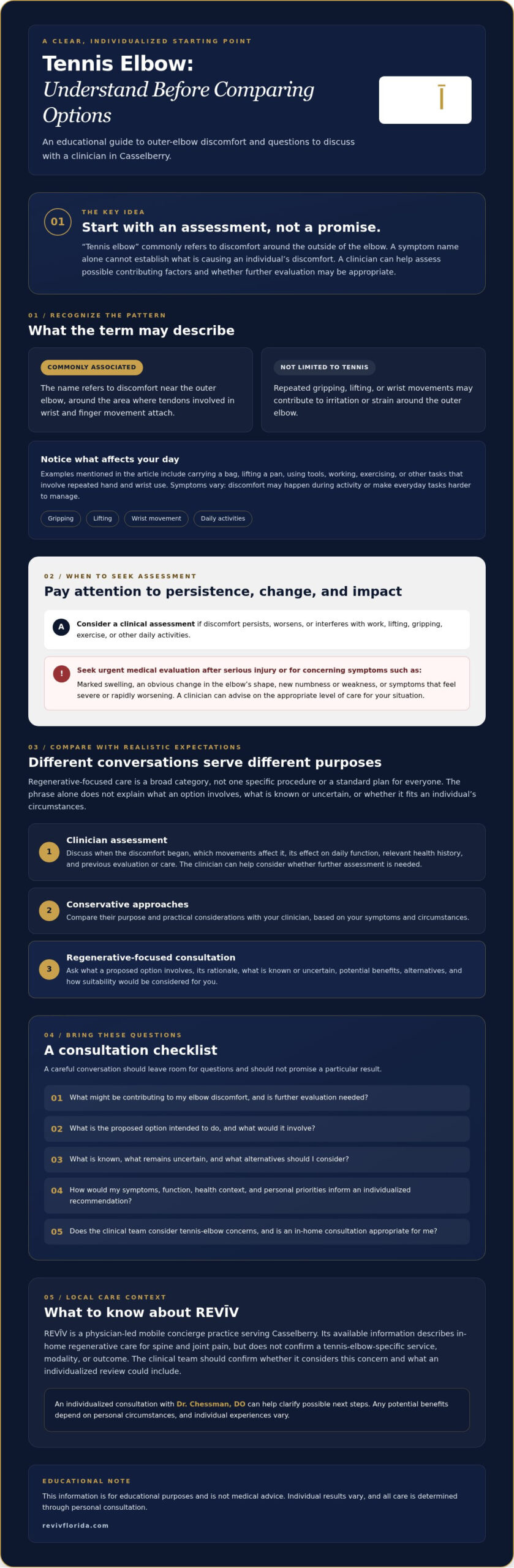
A Casselberry consultation checklist for evaluating regenerative care
A well-prepared consultation can make it easier to understand your options without rushing toward a decision. Before exploring regenerative therapy for tennis elbow Casselberry, gather a clear picture of what you’re experiencing and confirm that the practice considers this concern. A consultation is an opportunity to discuss your situation and possible next steps, not a promise that a particular service will be appropriate.
What information should you prepare?
Describe what you’ve noticed in your own words. You don’t need to identify the cause or arrive with a diagnosis. A few notes can make the conversation more useful:
- When the discomfort began and whether it has changed over time.
- Which movements or activities affect it, and how it influences work, exercise, or daily tasks.
- Any relevant evaluations or care you’ve already received, including what you found helpful or difficult.
- Your current medications and relevant health conditions for the clinician to review.
Bring questions, too. Ask what further assessment may be needed, what options could be considered, and what is known or uncertain about any proposed approach. Don’t stop existing care or change medication based on an article; discuss changes with a qualified clinician.
What should you confirm about local mobile care?
REVĪV is a physician-led mobile concierge practice serving Central Florida communities, including Casselberry, Orlando, Winter Park, Maitland, Altamonte Springs, Longwood, Orange City, DeLand, Deltona, Apopka, Oviedo, Winter Springs, Lake Mary, Sanford, Kissimmee, Winter Haven, Davenport, Titusville, Melbourne, and Melbourne Beach. Because availability and suitability can depend on individual circumstances, confirm whether the team currently considers tennis-elbow concerns and whether an in-home consultation is available for your location. Ask what the initial consultation involves, who will review your concerns, and what possible next steps may look like.
You can read more about the practice’s mobile regenerative medicine approach, then use these questions to decide whether to contact the team. A thoughtful consultation should leave you with a clearer understanding of the discussion, its limitations, and whether another type of evaluation or referral may be appropriate.
If you’d like to explore whether a conversation is a fit, request a private consultation. Any potential benefits depend on an individualized clinical review, and individual experiences vary.
Explore personalized next steps with REVĪV in Casselberry
Considering regenerative therapy for tennis elbow Casselberry begins with a practical question: does the concern fit the practice’s scope, and is a consultation appropriate for your circumstances? REVĪV is a physician-led mobile concierge regenerative medicine practice serving Central Florida, including Casselberry. The practice brings care to the patient, but tennis-elbow-specific service availability and suitability aren’t confirmed in its available information. Ask the team directly before making plans.
What a REVĪV consultation can help clarify
A personal conversation can focus on your goals, health context, and how elbow discomfort affects daily life. Dr. Cheesman, DO, is the clinical lead. The physician-led team can discuss whether your concern falls within the practice’s scope and what next steps may be appropriate. That discussion doesn’t mean a specific option or plan will be recommended; the right direction depends on individual clinical review.
Explain which activities matter most to you, such as completing work tasks, gripping comfortably, or returning to exercise. You can also ask what information the team would need to understand your situation, what uncertainties remain, and whether another type of evaluation or referral may be more suitable. The aim is to support an informed decision, not to assume that one approach fits everyone.
How to take the next step without pressure
Before arranging care, confirm that the team currently considers tennis-elbow concerns and ask whether an in-home consultation is available for your location in Casselberry. Clarify what an initial conversation involves and whether it’s intended to discuss your goals, health history, and possible next steps. A mobile concierge model brings care to the patient’s setting, but eligibility and service details still need to be confirmed individually.
For general background on REVĪV’s approach, see its information about regenerative therapy for shoulder and hip pain. This page provides broader context, not confirmation of an elbow-specific service. If you’d like to discuss whether a private conversation may be appropriate, request a private consultation. You don’t need to decide on a care path before asking your questions.
This information is for educational purposes and is not medical advice. Individual results vary, and all care is determined through personal consultation.
Choose your next step with clarity
Elbow discomfort can have different causes, so symptoms alone can’t confirm tennis elbow. A clinical assessment can help clarify what may be contributing and what next steps fit your health history, daily needs, and preferences. Regenerative-focused options aren’t one-size-fits-all. Clear conversations about evidence, uncertainty, and alternatives matter more than broad promises.
If you’re exploring regenerative therapy for tennis elbow Casselberry, REVĪV is a physician-led mobile concierge practice serving Central Florida, including Casselberry. Dr. Cheesman, DO, is the clinical lead. Confirm whether the team currently considers tennis-elbow concerns and whether an in-home consultation is available for your location. Any plan is individualized through personal consultation, and experiences vary.
When you’re ready, you can request a private consultation to discuss your situation and possible next steps. You deserve clear information and a thoughtful conversation as you decide what feels right for you.
Frequently Asked Questions
What is tennis elbow?
Tennis elbow is a common term for discomfort around the outer elbow, often associated with repeated forearm or wrist activity. Gripping, lifting, or using tools may bring on symptoms, but similar discomfort can have different causes. The name alone doesn’t confirm what’s happening. A clinician can review your symptoms, activity history, and health context to determine whether further evaluation is appropriate and discuss possible next steps.
Can regenerative therapy help with tennis elbow?
Whether a regenerative-focused option may be appropriate depends on an individual clinical assessment, and available options and evidence can vary. If you’re researching regenerative therapy for tennis elbow Casselberry, ask a clinician what is known about a proposed option, what remains uncertain, and whether your concern fits the practice’s scope. Don’t assume a particular procedure or outcome. Individual experiences and results vary.
Is regenerative-focused care appropriate for everyone with tennis elbow?
No single approach is appropriate for everyone. Before discussing options, a clinician needs to consider your symptoms, health history, any prior evaluation, and what matters to you in daily life. Ask what alternatives may be considered, what limitations or uncertainties apply, and whether further assessment or referral is appropriate. A consultation can help clarify possible directions, but it doesn’t guarantee eligibility for a specific service or plan.
How do I choose a regenerative medicine provider near Casselberry?
Ask who will be involved in your consultation, how your concerns will be assessed, and whether the practice considers tennis-elbow concerns. A provider should be able to discuss service scope, relevant evidence, uncertainties, potential risks, and alternatives without relying on broad outcome promises. REVĪV is a mobile concierge practice serving Central Florida, including Casselberry. Confirm current local availability and whether the concern fits the team’s scope before arranging care.
Does REVĪV offer in-home regenerative therapy for tennis elbow in Casselberry?
The available practice information confirms mobile care for spine and joint pain but doesn’t specify tennis-elbow services or a particular elbow-focused option. Contact REVĪV to ask whether the clinical team currently considers your concern, whether in-home service is available in Casselberry, and what an initial assessment may involve. A consultation can help clarify possible next steps, but it doesn’t guarantee that a specific service or plan will be offered.
What should I ask during a tennis-elbow consultation?
Ask what may be contributing to your symptoms and what evaluation is appropriate. You can also ask which options and alternatives may be considered, what is known or uncertain about them, and what potential risks or practical requirements to understand. Find out how the clinician would review your progress and when another specialist may be appropriate. Share relevant health history and prior evaluations, and don’t rely on online information to diagnose yourself.
Can I receive a consultation at home in Casselberry?
REVĪV describes itself as a mobile concierge practice serving Central Florida, including Casselberry. Contact the team to confirm current availability in your location, the format of an initial consultation, and whether your concern fits its scope. Mobile care doesn’t mean every service is available to every person. Any discussion of potential options and next steps depends on personal consultation, and individual experiences and results vary.
Disclaimer
For educational purposes only; not medical advice. Regenerative approaches
referenced are not FDA-approved to diagnose, treat, cure, or prevent any disease.
Individual results vary. Care is determined through individual consultation.
