

Tired of Living With Chronic Back Pain? Understand Your Options
What if the next step for back pain is understanding what may be contributing to it, rather than simply trying another option? If you’re tired of living with chronic back pain, the effects can reach beyond discomfort. Pain may disrupt sleep, limit movement, and make work or valued activities harder. When previous approaches haven’t matched your needs, it’s understandable to want a clearer view of what comes next.
Persistent back pain can have different contributing factors, so care calls for an individualized approach rather than a one-size-fits-all promise. This article compares common pathways, including conservative care, non-surgical regenerative-focused options, and surgery, and offers practical questions to discuss with a physician. Regenerative-focused options are designed to support the body’s natural repair and recovery processes. Whether they may be appropriate depends on your individual circumstances and a personal consultation.
REVĪV is a physician-led mobile concierge practice serving Central Florida, with in-home consultations for back and spine concerns. The clinical team can help you discuss your history, priorities, and options with care and clarity. This information is for educational purposes and is not medical advice. Individual results vary, and all care is determined through personal consultation.
Key Takeaways
- If you’re tired of living with chronic back pain, note how it affects your routines, rest, work, and confidence. These details can clarify what matters most to you.
- A useful clinical conversation connects your back-pain history, prior evaluations, and experience with earlier approaches to your current goals.
- Compare movement-based care, medication discussions, procedures, surgery, and regenerative-focused options by their purpose, trade-offs, and fit for your priorities.
- Prepare a concise summary of your symptoms, current care, goals, and questions so you can make better use of your time with a physician.
- An in-home, physician-led consultation gives you space to discuss personalized regenerative-focused options and the uncertainties that remain.
When Back Pain Persists, Start by Understanding What Has Changed
Back pain that lingers can quietly reshape your day. You may move more cautiously, wake while trying to rest, find work harder to manage, or turn down activities that once felt routine. If you’re tired of living with chronic back pain, it makes sense to want answers. A useful first step is to notice what has changed rather than assume the pain points to one particular cause.
Persistent or chronic back pain is pain that continues over time. It’s commonly described as chronic when it lasts longer than 12 weeks. The overview of Understanding Chronic Back Pain also describes the distinction between shorter-term and chronic back pain. Duration provides context, but it doesn’t explain why your back hurts or determine which approach is right for you.
Back pain is a symptom; the factors contributing to it need careful consideration. Keeping that distinction in mind can make a conversation about next steps more focused and individualized.
Why the same back-pain experience can have different contributors
The lower back is a connected area, not a single structure. Bones and joints work alongside discs, muscles, ligaments, and other soft tissues. Strain, age-related or other degenerative changes, and nerve irritation are among the possible contributors to back symptoms. These examples provide context, not a diagnosis. A clinician considers your history and circumstances to understand what may be relevant.
People can describe similar experiences, such as aching during movement or discomfort after sitting, even when different factors are involved. The reverse can also happen: people with similar findings may report different symptoms or have different priorities. A symptom alone doesn’t establish its source or show that the same care pathway will suit everyone. Individual assessment helps put the pieces together instead of relying on a label or a single detail.
When pain changes daily life, reassess the next step
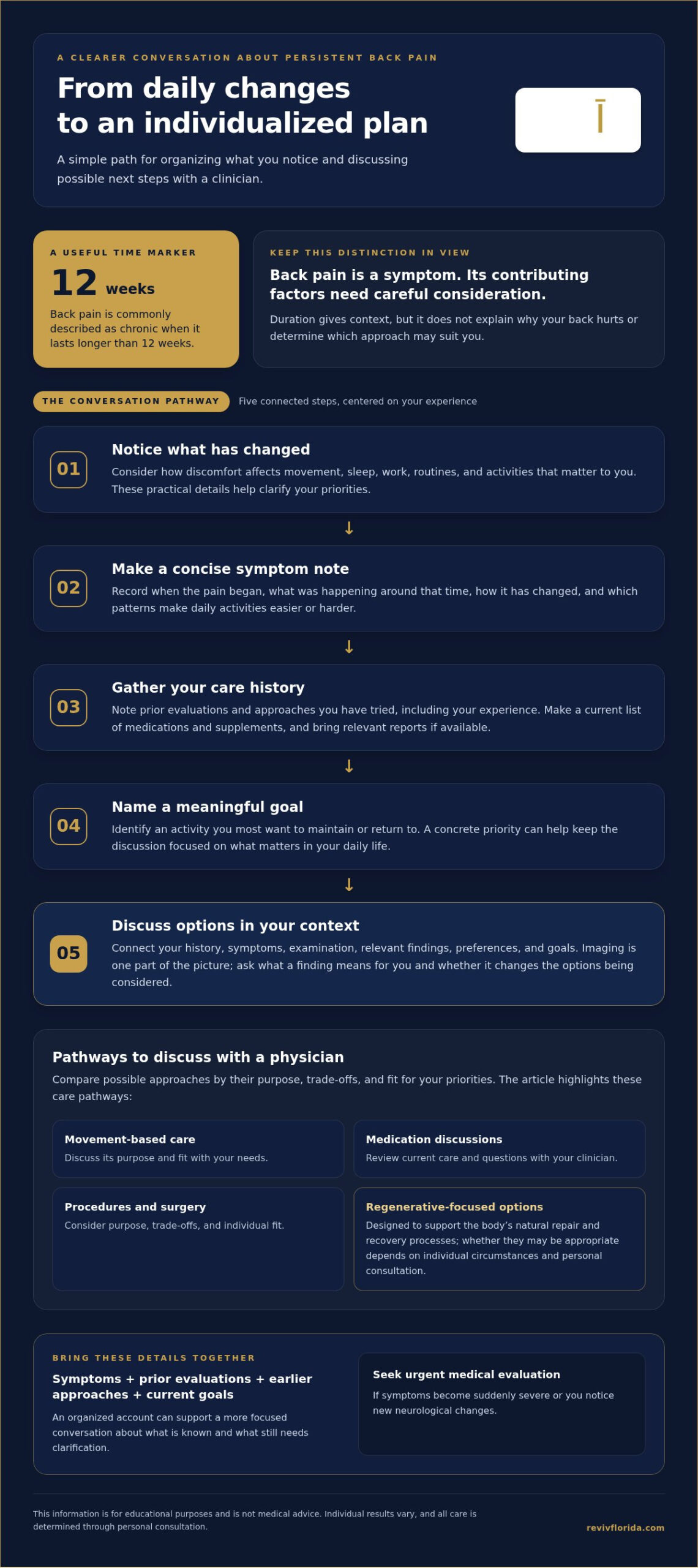
Consider how the discomfort affects your routine. Does it limit bending, walking, or changing position? Does it interrupt sleep, make a workday harder, or keep you from an activity you value? These practical details can help a clinician understand the impact and what you hope to regain or maintain.
A concise history can make the discussion clearer. Jot down:
- When the pain began and what was happening around that time.
- How it has changed, including patterns that make daily activities easier or harder.
- Prior evaluations and what you learned from them.
- Approaches you’ve tried and how you experienced them.
Share any relevant current care as well. If symptoms become suddenly severe or you notice new neurological changes, seek urgent medical evaluation. For other persistent concerns, an organized account of what has changed can support a more thoughtful discussion about possible next steps.
A Better Back-Pain Plan Begins With Individual Assessment
A useful assessment looks beyond the description of discomfort. It helps a clinician understand how your symptoms relate to your health history, daily function, priorities, and relevant clinical context. That broader view can make an options discussion more specific and distinguish what is known from what still needs clarification.
An individualized assessment should come before discussing options because recommendations need to reflect the person, not just the symptom. Prepare by considering what you want help understanding, what matters most in daily life, and which questions you’d like answered. The Trusted Information on Back Pain from MedlinePlus offers general background that may help you organize questions for a clinician.
What to bring into a back-pain consultation
A brief written note can be more helpful than trying to recall every detail during a conversation. Include when symptoms began, whether they have changed, and which movements or situations seem to affect them. If discomfort varies through the day, note that pattern too. These observations provide context, but they don’t establish a cause on their own.
Gather details about previous evaluations and approaches you’ve tried, including what you remember about your experience. Make a current list of medications and supplements to discuss, and bring relevant reports if you have them. This can help the clinician understand what has already been considered and make it less likely that important questions are overlooked.
Describe your goals in concrete terms. Rather than focusing only on a general wish to feel better, consider which activity you most want to maintain or return to. A specific priority can guide a conversation about what matters to you while leaving room for realistic discussion about individual needs and expectations.
How goals and history shape an individualized plan
Imaging findings are one part of the picture. A clinician interprets them alongside your symptoms, examination, and history, since a scan alone may not explain your experience. If a report uses unfamiliar language, ask what a finding means in your circumstances and whether it changes the options being considered.
Your preferences and previous experiences matter too. A physician-led team can discuss possible next steps in light of the information you share, rather than assuming a standard approach suits everyone. For more context on non-surgical options, explore regenerative medicine for spine pain in Orlando.
If you’d like to talk through your questions and priorities, you can request a private consultation. The conversation can help clarify what may be relevant to your situation and what you’d like to consider next.
Compare Back-Pain Care Pathways by Purpose, Trade-Offs, and Fit
Back-pain options serve different purposes. They aren’t interchangeable, and an approach that suits one person may not fit another person’s history, symptoms, or priorities. Comparing what each pathway generally involves can help you ask focused questions without assuming one choice is right for everyone.
| Pathway | General purpose | Questions to discuss with a clinician |
|---|---|---|
| Movement-based care | Support physical activity and function through approaches such as guided exercise or movement education. | What kinds of movement may suit my current abilities and goals? How should I adapt activity if my symptoms change? |
| Medication discussions | Consider whether medication has a role in a broader care plan, taking personal health context into account. | What potential benefits, risks, and interactions should I consider with my current medications or supplements? |
| Procedures | Discuss whether a targeted medical procedure may be relevant to an individual’s circumstances. | What is the procedure intended to do, what are its risks, and what alternatives should I understand? |
| Surgery | Consider an operation for selected spinal concerns following individualized medical evaluation. | What findings and goals inform this option, and what should I understand about recovery and other pathways? |
| Regenerative-focused options | Explore a non-surgical approach and whether it may align with the person’s clinical context and priorities. | Could this option be appropriate for me? What uncertainties, considerations, and alternatives should I discuss? |
What conservative and procedural pathways are generally intended to address
Movement-based care may focus on maintaining or building function, with activity adapted to the person. Medication discussions involve reviewing health history, other medications, possible benefits, and potential risks with a clinician. For procedures, ask about their purpose and relevance to your individual evaluation. Surgery is a distinct pathway, not simply a more intensive version of conservative care. Whether it belongs in the discussion depends on medical evaluation. The Spine Health Resources from the National Spine Health Foundation offer additional educational information about back and neck health.
Where regenerative-focused options may enter the conversation
Regenerative-focused options aren’t a guaranteed substitute for movement-based care, medication discussions, procedures, or surgery. Their suitability and potential benefits need to be considered in an individual consultation, and experiences vary. REVĪV provides non-surgical, regenerative-focused care for spine and back concerns through a mobile concierge model. For details about this approach, explore in-home regenerative medicine in Orlando. A private consultation can help you discuss how this pathway relates to your history and goals.
Prepare for a More Useful Conversation About Chronic Back Pain
A little preparation can help you make good use of a consultation. If you’re tired of living with chronic back pain, it may be hard to know which concern to bring up first. A short, organized summary can help you explain what matters and leave room for questions that come up during the conversation.
Before your appointment, consider preparing a few notes:
- Summarize your history. Note when symptoms began, how they’ve changed, and what seems to affect them. Include previous evaluations and approaches you’ve tried.
- Describe your goals. Identify activities you hope to maintain or return to, such as taking a walk, managing a workday, or enjoying a hobby.
- List your current care. Write down medications, supplements, and other approaches you’re currently using, along with questions about them.
- Choose your questions. Note what you most want to understand about your options, including anything that remains unclear.
Questions that make an options discussion more specific
Focused questions can help clarify how a recommendation relates to your situation. Consider asking:
- Which parts of my history or evaluation inform this recommendation?
- What is this option intended to support, and what are its limitations?
- What risks, alternatives, or uncertainties should I consider?
- How might we review my experience over time, and what could lead us to reconsider the plan?
You can also ask how an option aligns with your priorities and what follow-up may involve. A useful discussion makes room for both benefits and limitations, without requiring you to decide before you feel informed. If you need time to consider what you’ve heard, say so.
When a routine consultation is not the right next step
Some symptoms need prompt attention rather than routine planning. New weakness, loss of bladder or bowel control, or severe sudden symptoms warrant immediate medical evaluation. If symptoms are urgent or rapidly worsening, seek immediate medical care. A routine consultation is not a substitute for emergency assessment.
For non-urgent questions, discussing your priorities with a physician can help you consider possible next steps. If you’d like to explore a personalized conversation about regenerative-focused spine care, you can request a private consultation. Individual experiences vary, and any potential benefits depend on your circumstances.
Personalized In-Home Back-Pain Care in Central Florida
Understanding your options is one part of making a considered decision. The next is finding a care conversation that takes your history, concerns, and goals seriously. REVĪV is a physician-led mobile concierge practice serving Central Florida, including Orlando. The clinical team brings care to the patient, with in-home consultations for people exploring non-surgical, regenerative-focused options for spine and back concerns.
What personalized, mobile concierge care means
An in-home setting can make it easier to discuss your experience in a familiar environment. The conversation can focus on what you’ve noticed, what matters in your daily life, and what you hope to understand about possible next steps. It’s a personal consultation, not a one-size-fits-all protocol or a promise of a particular result.
Led by Dr. Cheesman, DO, the physician-led team discusses whether regenerative-focused spine care may fit your circumstances. These options are designed to support the body’s natural repair and recovery processes. Potential benefits, limitations, and considerations depend on your individual consultation, and experiences and results vary. The aim is to support an informed discussion, not to suggest one approach is right for everyone.
Personalization also means making room for your questions. Share which activities matter most, what you’ve already explored, and what uncertainties you still have. That context helps shape a conversation around your needs and preferences, rather than assuming your next step in advance.
A thoughtful next step when you are ready
A measured decision can follow a few clear steps: understand your situation and relevant history, compare care pathways by their purpose and trade-offs, then discuss with a physician which options may fit your priorities. Take time to consider what you’ve learned and raise further questions before deciding what feels appropriate for you.
If you’d like to explore a personalized, in-home discussion about regenerative-focused spine care, request a private consultation. There’s no need to arrive with a decision already made. The conversation can help you clarify what to ask and whether this approach aligns with your goals.
This information is for educational purposes and is not medical advice. Individual results vary, and all care is determined through personal consultation.
Choose a Next Step That Respects Your Priorities
If you’re tired of living with chronic back pain, moving forward doesn’t have to mean choosing an option before you feel ready. Start by deciding what you want a care conversation to clarify: which questions matter most, what trade-offs you’re comfortable considering, and what you hope to preserve or regain in daily life.
Keep those priorities in mind as you weigh possible next steps. A useful plan leaves room for honest questions, clear explanations, and your preferences. It should also allow the conversation to evolve as your needs and experience change. There’s value in taking a considered step, even when every answer isn’t available at once.
If you’d like physician-led guidance as you consider a personalized approach, request a private consultation with REVĪV. You can begin with a conversation, explore what may fit, and decide at your own pace. The team provides mobile concierge care in Central Florida, bringing the consultation to you.
Frequently Asked Questions
Can chronic back pain improve without surgery?
Yes, back pain can sometimes improve without surgery, though no single approach fits everyone. A clinician may discuss activity adjustments, guided movement, or other non-surgical options based on your health, goals, and evaluation. Ask what each option is intended to support, what limitations or risks to consider, and how you’ll review whether it remains appropriate. Changes in your symptoms are useful to share, but they don’t by themselves identify the cause.
Is chronic back pain always caused by a problem in the spine?
No. Back discomfort can involve muscles and other soft tissues, joints, discs, nerves, or factors outside the spine. Sometimes the source isn’t clear from symptoms alone, and an imaging finding may not fully explain how you feel. A clinician considers your history and examination together to understand what may be contributing. Avoid drawing conclusions from a scan or symptom description without discussing it in context.
What should I do if chronic back pain keeps returning?
If you’re tired of living with chronic back pain that keeps returning, arrange a conversation with a physician to review what has changed and what you’ve tried. Note when flare-ups happen, how long they last, and whether they affect particular activities or coincide with changes in your routine. Bring that pattern to the discussion. Seek urgent medical evaluation for sudden severe symptoms or new neurological changes.
Can chronic back pain affect sleep, mood, or daily activities?
Yes. Ongoing discomfort may make it harder to find a comfortable sleeping position, concentrate at work, stay active, or enjoy social plans. Interrupted rest and reduced participation can also affect mood and energy. Mention these effects during an evaluation, even if they seem separate from the back symptoms. For example, explain whether discomfort wakes you, limits a household task, or leads you to avoid an activity you value.
How do physicians assess persistent back pain?
Physicians typically ask about your health history, symptom pattern, daily function, and previous evaluations, then consider findings from a physical examination. They may ask about sensations such as tingling or weakness, as well as movements that change your symptoms. Imaging or other tests are considered in light of the clinical picture, rather than interpreted on their own. You can ask how each finding relates to your experience and what remains uncertain.
Are regenerative-focused options appropriate for every person with back pain?
No. A regenerative-focused option may not suit every person or every set of circumstances. A physician-led consultation can consider your health history, symptoms, goals, and other care when discussing whether an option may be appropriate. Ask what it is designed to support, what limitations or uncertainties apply, and what alternatives may be relevant. Individual experiences and results vary, and suitability is determined through personal consultation.
Can I receive concierge back-pain care at home in the Orlando area?
Yes. REVĪV is a physician-led mobile concierge practice providing in-home regenerative-focused care in Orlando and Central Florida communities, including Winter Park, Maitland, Altamonte Springs, Longwood, Casselberry, Orange City, DeLand, Deltona, Apopka, Oviedo, Winter Springs, Lake Mary, Sanford, Kissimmee, Winter Haven, Davenport, Titusville, Melbourne, Melbourne Beach, Lakeland, and Plant City. Care is discussed through personal consultation and tailored to individual circumstances.
Disclaimer
For educational purposes only; not medical advice. Regenerative approaches
referenced are not FDA-approved to diagnose, treat, cure, or prevent any disease.
Individual results vary. Care is determined through individual consultation.
